


KARACHI: Pakistan today on Friday celebrationg the 106th birth anniversary of Shaheed Hakim Mohammed Said, one of the country’s most revered scholar-physicians, educationists, and institution builders, whose intellectual and humanitarian legacy continues to influence national discourse on education, healthcare, and ethics more than two decades after his martyrdom.
Born on January 9, 1920, Hakim Mohammed Said emerged as a rare intellectual figure who successfully bridged tradition and modernity at a time when Pakistani society was increasingly polarized between inherited knowledge systems and contemporary scientific thought. His life’s work reflected a consistent effort to integrate Islamic scholarship, Eastern medicine, and modern education within a coherent ethical framework-an approach that remains relevant amid today’s complex socio-economic challenges.
Analysts observe that Hakim Mohammed Said’s relevance has, in fact, intensified with time. In an era marked by the commercialization of education, erosion of academic standards, and widening social inequality, his model of institution-building-anchored in service rather than profit-stands in sharp contrast to prevailing trends. Through the Hamdard movement, he demonstrated that sustainable philanthropy and rigorous scholarship could coexist without compromising integrity or purpose.
Central to his vision was Madinat al-Hikmah, conceived as a “City of Wisdom” rather than a conventional campus. Designed to integrate universities, research centers, healthcare institutions, libraries, and cultural forums, it represented a civilizational approach to education inspired by classical Islamic traditions of knowledge. Observers argue that this integrated model remains among the most comprehensive intellectual projects undertaken in Pakistan’s post-independence history.
Hakim Mohammed Said was also a leading advocate of Eastern medicine, particularly the Unani system, at a time when it faced marginalization within formal academic and regulatory frameworks. Instead of resisting modern science, he called for scientific validation and research-based integration, positioning traditional medicine as a complementary discipline rather than an alternative rooted in nostalgia. His scholarly journals and edited works played a crucial role in preserving, documenting, and professionalizing this field.
Beyond medicine and education, his contribution to intellectual life extended through extensive editorial work, including journals on Islamic studies, medical sciences, and public health, which provided sustained platforms for scholarly debate. These publications, analysts note, helped maintain continuity in academic traditions at a time when intellectual discourse was increasingly fragmented.
His assassination in October 1998 was widely regarded as a profound loss not only for Pakistan but for the broader Muslim intellectual world. However, experts point out that the continued functioning and growth of Hamdard institutions underscore a defining aspect of his legacy: ideas embedded in institutions are far more resilient than those tied solely to individuals.
On his 106th birth anniversary, educationists and policy observers argue that Hakim Mohammed Said’s life offers important lessons for contemporary Pakistan. His emphasis on ethics in education, integration of knowledge systems, and long-term institution-building contrasts sharply with short-term policy cycles and market-driven approaches that dominate the sector today.
As the country reflects on more than a century since his birth, Shaheed Hakim Mohammed Said’s legacy continues to serve as a benchmark in debates on national development-reminding policymakers, educators, and society at large that sustainable progress depends not only on economic growth, but on knowledge guided by moral responsibility.
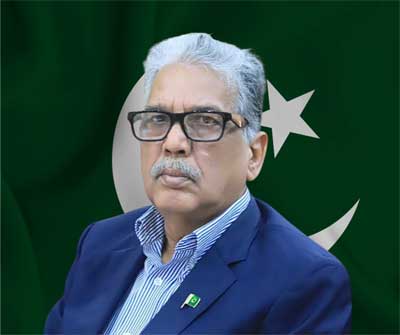
106th birth anniversary of Shaheed Hakim Mohammed Said
Previous article

Next article

