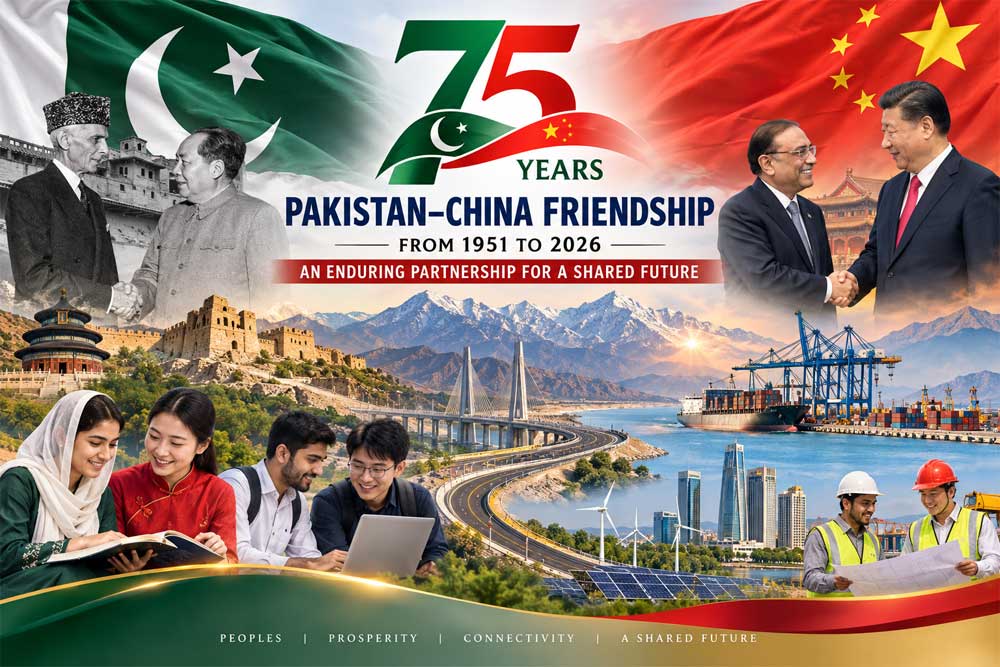
As Pakistan and China commemorate 75 years of diplomatic relations in 2026, the occasion represents far more than an anniversary on the diplomatic calendar. It is a celebration of one of the most enduring relationships in contemporary international affairs – a friendship that began formally in 1951 and has steadily developed into an All-Weather Strategic Cooperative Partnership.
Pakistan was among the early countries to recognize the People’s Republic of China, and formal diplomatic relations were established on May 21, 1951. What followed over seven and a half decades is a remarkable story of mutual trust, respect and support that has survived major transformations in the regional and international order.
Successive generations of Pakistani and Chinese leadership have contributed to strengthening this relationship. Governments have changed, international alliances have shifted and the geopolitical landscape has repeatedly been transformed, yet the fundamental character of Pakistan-China relations has remained remarkably consistent.
The importance attached to this relationship was again evident during Prime Minister Mian Muhammad Shehbaz Sharif’s visit to China in May 2026, when he met President Xi Jinping and Premier Li Qiang as the two countries commemorated the 75th anniversary of diplomatic relations. Both sides reaffirmed their determination to further deepen their All-Weather Strategic Cooperative Partnership and accelerate the building of an even closer China-Pakistan Community with a Shared Future in the New Era.
From Karakoram to CPEC
Few symbols capture the evolution of this friendship better than the Karakoram Highway. Built through some of the world’s most challenging terrain, the highway became a physical manifestation of the determination of Pakistan and China to connect their peoples and economies.
Decades later, that spirit of connectivity acquired an entirely new dimension through the China-Pakistan Economic Corridor (CPEC).
As a flagship project of President Xi Jinping’s Belt and Road Initiative (BRI), CPEC transformed Pakistan-China cooperation from a predominantly strategic and diplomatic partnership into an increasingly comprehensive economic relationship.
Energy projects, highways, transport networks, Gwadar Port and other infrastructure initiatives have helped address critical development requirements and created a foundation upon which the next phase of cooperation can be built.
But CPEC should not be viewed merely as a collection of infrastructure projects. Its greater significance lies in its potential to reshape Pakistan’s economic geography by connecting Gwadar and the Arabian Sea with western China and wider regional markets.
The challenge before Pakistan now is to translate this infrastructure into sustained economic productivity.
From the Ancient Silk Road to Modern China: A Personal Journey
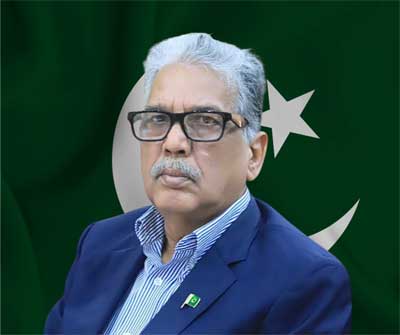
My own association with China has provided me with the privilege of witnessing its remarkable transformation first-hand. Between 2014 and 2025, I visited China nine times, travelling to various cities, interacting with government officials, academics, journalists and people from different walks of life, and observing closely the extraordinary pace of the country’s development.
My first visit to China in 2014 took me to Xi’an, the historic city associated with the starting point of the ancient Silk Road. Standing at a place from where traders and travellers once embarked upon journeys connecting China with distant civilizations was particularly meaningful at a time when the vision of the Belt and Road Initiative was beginning to take shape.
The ancient Silk Road was not simply a trade route. It was a bridge between civilizations, carrying ideas, knowledge, cultures and human relationships alongside merchandise. More than two thousand years later, the BRI seeks, in a modern context, to revive that spirit of connectivity through infrastructure, trade and economic cooperation.
During my subsequent visits over the next eleven years, I travelled through different Chinese cities and witnessed the speed with which the country continued to transform. Modern transportation systems, expanding infrastructure, urban development and technological advancement demonstrated how effectively long-term planning and national determination can translate into visible progress.
Each visit offered something new. Places I had previously seen appeared further developed when I returned. China’s transformation was not something I was merely reading about in economic reports or official documents; I was witnessing elements of it with my own eyes.
Yet some of my most lasting memories of China are not of highways, high-speed trains, skyscrapers or major development projects.
Visits to museums, historical sites and beautifully maintained public parks revealed another dimension of China – a nation moving rapidly towards the future while remaining deeply conscious of its history, civilization and cultural heritage.
I particularly remember observing elderly Chinese citizens spending time in public parks with their children, grandchildren and, in some cases, several generations of their families together. These were simple scenes, but they left a lasting impression on me. They demonstrated that behind the extraordinary story of China’s modernization remains a society where family bonds, respect for elders and continuity between generations retain considerable importance.
My meetings and interactions with Chinese officials and ordinary citizens also allowed me to experience personally the warmth associated with Pakistan. The description of Pakistan and China as “iron brothers” is frequently heard in diplomatic discourse, but during my visits I found that the sentiment extends well beyond official meeting rooms.
For a Pakistani journalist who has had the opportunity to visit China nine times over more than a decade, perhaps the most striking feature has been this combination of continuity and change – extraordinary economic, technological and infrastructural transformation alongside a strong consciousness of history, culture and family.
These experiences have strengthened my conviction that Pakistan-China relations cannot be measured only through agreements, investments, projects or diplomatic statements. The real strength of this relationship must ultimately be found in people knowing, understanding and respecting one another.
CPEC 2.0: The Next Chapter
The future of Pakistan-China economic relations will increasingly be defined by CPEC 2.0.
The emphasis is moving towards industrialisation, Special Economic Zones, agriculture, information technology, mining, renewable energy, scientific cooperation and export-oriented development.
This transition is essential. Roads and power plants provide the foundation, but factories, technology, skills, exports and productive employment must provide the long-term economic dividend.
Pakistan must therefore create an environment in which Chinese companies can confidently establish industries, enter joint ventures with Pakistani businesses and use Pakistan as a production and export base.
China’s extraordinary economic transformation also offers important lessons. Its experience demonstrates the importance of infrastructure, human capital, technological advancement, long-term planning and an export-oriented industrial base.
Having witnessed China’s development during repeated visits over eleven years, I believe there is much Pakistan can study from the consistency of its development planning and implementation. Pakistan need not replicate China’s development model, but it can certainly learn from China’s experience while developing solutions suited to its own circumstances.
A Strategic Partnership Beyond Economics
Economics, however, represents only one dimension of this relationship.
Defence and security cooperation has remained a central pillar of Pakistan-China ties. The longstanding relationship between the Pakistan Armed Forces and China’s People’s Liberation Army encompasses professional exchanges, training, defence production and technological cooperation.
At the diplomatic level, Pakistan and China have consistently supported each other on issues considered important to their respective national interests. Their coordination extends to international and regional forums, including the United Nations and the Shanghai Cooperation Organisation.
The relationship therefore carries strategic importance not only for Islamabad and Beijing but also for the broader objective of regional stability and development.
In an increasingly uncertain international environment, Pakistan and China have emphasized dialogue, peaceful coexistence, development and respect for sovereignty. Their partnership can make an important contribution to a more connected and economically integrated region.
Friendship Must Reach the People
The next 25 years, however, cannot depend exclusively on government-to-government relations.
The strongest guarantee for the future of Pakistan-China friendship will be deeper people-to-people connectivity.
My own experiences in China have convinced me that personal interaction can achieve something that official agreements alone cannot. When people visit each other’s countries, experience their cultures and understand their societies, international friendship acquires a genuinely human dimension.
Thousands of Pakistani students have studied in China, while educational institutions, businesses, media organizations and cultural bodies are developing increasingly close relationships. These exchanges must expand considerably.
Young Pakistanis should know more about Chinese society, history, language, technology and development, while Chinese citizens should have greater opportunities to understand Pakistan’s history, culture, economic potential and people.
Universities should undertake joint research. Journalists and scholars should exchange ideas. Businesses should establish partnerships. Tourism should expand. Students should interact more frequently.
A strategic relationship becomes truly enduring when it is understood and valued not only in government offices but also in classrooms, workplaces, universities, parks and communities.
Protecting a Shared Future
Pakistan also carries a serious responsibility to ensure the safety and security of Chinese nationals, institutions and projects working in the country.
Those who target Chinese citizens seek not only to take innocent lives but also to undermine Pakistan’s economic development and one of its most important international partnerships.
Ensuring their protection must therefore remain a national priority.
At the same time, the benefits of CPEC and Chinese investment must increasingly reach local communities through jobs, education, skills development and economic opportunities. This is particularly important in areas hosting major projects.
Security and development ultimately reinforce each other.
Towards the Next 25 Years
The celebration of 75 years of Pakistan-China diplomatic relations should not merely encourage us to look back. It should compel us to look forward.
By 2051, when the two countries mark a century of diplomatic relations, today’s young Pakistanis and Chinese will be leading their nations.
What kind of relationship will they inherit?
The answer depends upon the decisions taken today.
The next chapter should transform the political and strategic strength of Pakistan-China friendship into deeper economic integration, technological cooperation, industrial development, educational partnerships and greater interaction between the two peoples.
The foundation is already exceptionally strong.
From the establishment of diplomatic relations in 1951, through the Karakoram Highway and decades of diplomatic and defence cooperation, to CPEC and the Belt and Road Initiative, Pakistan and China have repeatedly demonstrated their ability to turn friendship into practical cooperation.
My own journey – from standing at the historic starting point of the Silk Road in Xi’an in 2014 to witnessing China’s continuing transformation during nine visits through 2025 – has given me a personal perspective on what sustained vision, connectivity and development can achieve.
Seventy-five years after the establishment of diplomatic relations, Pakistan and China stand at another important threshold.
The task ahead is to ensure that this historic friendship becomes an even stronger force for peace, development, connectivity and shared prosperity – not only for Pakistan and China but for the wider region.
As China celebrates the 77th anniversary of the founding of the People’s Republic of China, Pakistan joins its Chinese brothers and sisters in celebrating their achievements and looking towards a future of even deeper cooperation.
The first 75 years built the foundation. The next 25 must build the future.
Long live Pakistan-China friendship!