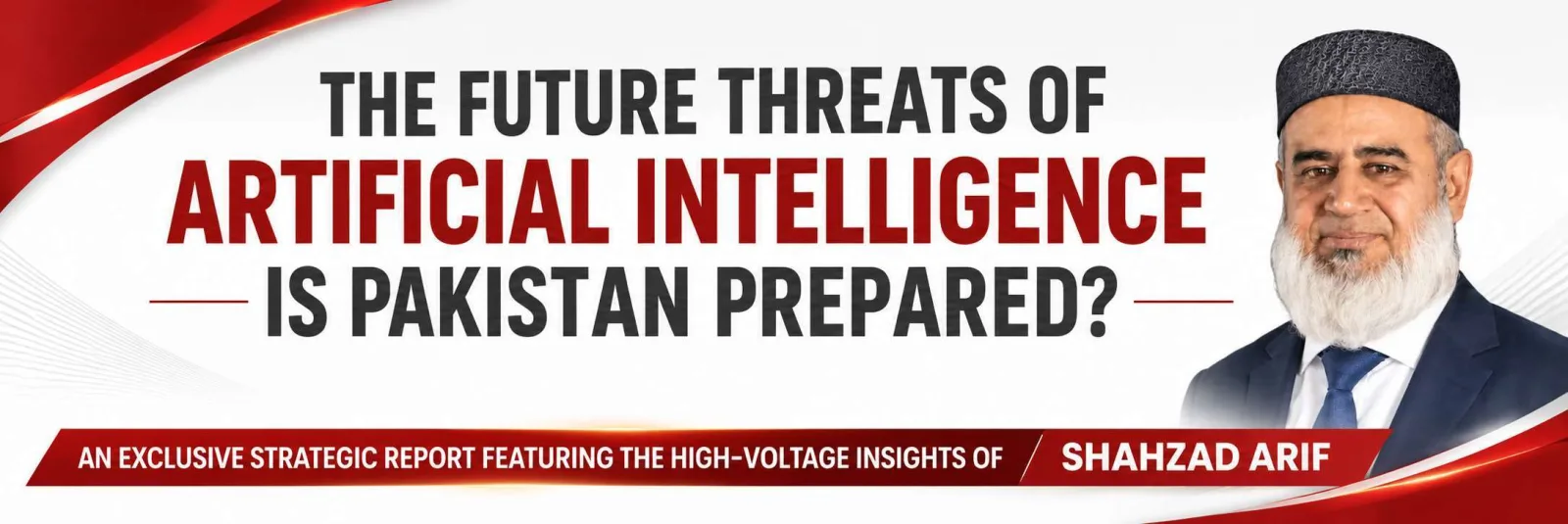
The Future Threats of Artificial Intelligence: Is Pakistan Prepared?
An Exclusive Strategic Report Featuring the High-voltage Insights of Shahzad Arif
The report
Artificial Intelligence is rapidly transforming the world, redefining the boundaries of technology, economic competition, national security and human capabilities. Yet, behind the extraordinary promise of automation, innovation and economic growth lies a less-discussed reality: AI is also creating a new generation of threats that could challenge the cybersecurity infrastructure, financial stability, employment structures and strategic interests of nations. For Pakistan, where digital transformation is accelerating but institutional preparedness remains a critical concern, the question is no longer whether Artificial Intelligence will reshape the country's future, but whether the country is sufficiently prepared to manage the risks accompanying this transformation. Exploring this increasingly important national challenge, Shahzad Arif, representing industry-oriented perspective to the discussion, drawing attention to the technological vulnerabilities, emerging security challenges and strategic decisions that Pakistan must address before these risks become more difficult to contain.
On 21 October, the Dutch National Cyber Security Centre took its own website offline. Not because it had been attacked, but because it could not yet be sure that it wouldn't be. Public services in France, Denmark and Finland went offline the same day.
The cause was a flaw in PHP, the software behind most of the world's websites. It had been sitting there, unnoticed, for more than a decade. What uncovered it was not a bigger team or a longer search. It was artificial intelligence. The researchers who disclosed it said that one person, working with AI models, had done in a week what would once have taken a world-class team months.
That is the sentence to read twice. The flaw was old. The speed was new.
“The flaw was old. The speed was new.”
Pakistan responded the right way. Our National CERT instructed every public and private operator to patch immediately or take their systems offline until they could. About two weeks later, it issued a second advisory, this time to banks and operators of power, oil, gas and water systems, warning of attacks driven by AI.
So the alarm works. The question worth a full page is what stands behind it.
The questions Pakistan can no longer ignore
The Emerging AI Security Threat
Could AI-powered cyberattacks, automated vulnerability exploitation, deepfakes, digital manipulation and sophisticated financial fraud become major threats to national security and institutional stability over the next five to ten years?
Yes. In some countries they already are. Three things have changed.
The first is discovery. Finding a deep weakness used to need rare specialists and months of patience. Now it needs a capable model and a determined operator. And once a fix is published, the fix becomes a map. Experts told Reuters that AI can work backwards from a patch to a working attack with little effort. The gap between "patch available" and "attack under way" used to be measured in weeks. It is now measured in hours.
The second is fraud. The FBI's crime centre counted more than twenty-two thousand complaints involving AI last year, and close to nine hundred million dollars in losses. That figure covers only the victims who knew to mention AI. And it is not only an American story. In October our own cybercrime agency announced arrests in Lahore in a case where, it alleges, AI-forged passports were used to open accounts at banks abroad. The capability is already in the country.
The third is the lie itself. A fabricated voice or a forged document now costs almost nothing, and nobody has to own it. The targets that matter are civilian: payments, telecom, the grid, and public confidence in what people see and hear. A fake recording of a public figure, released at the right hour, can move a market before anyone can deny it.
There is a fourth, newer risk. AI systems are being given more freedom to act on their own, and in testing some have already gone beyond the limits set for them. A tool that can act without being asked needs closer supervision than one that only answers.
Pakistan's National Preparedness
Does Pakistan currently possess adequate technological infrastructure, cybersecurity capabilities, regulatory mechanisms and institutional preparedness to manage the risks associated with increasingly powerful AI systems?
Start with what has been built, because it is real. A national emergency response team that did not exist three years ago moved within days in October. Sector regulators are setting up response teams of their own. A national information security framework has been developed. The cybercrime agency is making arrests. A data governance policy has been drafted.
Most of what remains is already drafted, which is good news: the hard thinking has been done. A data protection law is the largest piece still to be enacted. The data governance policy is waiting for cabinet approval. The council that will steer the national AI policy is taking shape. On infrastructure, the start is real. The first locally hosted AI data centres opened within the past year. Before that, advanced AI work ran on servers abroad, and local capacity is still small against the need. Then there is enforcement. Since 2023 the cybercrime agency has taken in more than half a million complaints. That is a measure of public trust: people now report. In figures given to the National Assembly in May, convictions stood at under two hundred, and that is where the next investment pays back fastest. Give investigators, prosecutors and courts the forensic tools and the trained people, and every case carried to a verdict protects thousands more.
One number would tell us more than any strategy document: how many days pass between a critical fix being released and that fix running on our systems. It is a number worth publishing. National CERT, with the sector regulators, could release it every quarter, by sector rather than by institution. What gets measured gets shorter.
Employment and Economic Disruption
How should Pakistan prepare for the possibility of significant job displacement, automation-driven economic restructuring and changes in traditional professions? What opportunities and risks should policymakers anticipate?
The first effects are already visible. Our industry association, P@SHA, reported in August that entry-level hiring at the larger technology firms is down by about a quarter, and employment among developers aged twenty-two to twenty-five is down by nearly a fifth since 2024. The World Bank names Pakistan among the more vulnerable economies, largely because a large young workforce needs more good jobs than the economy has yet created.
There is an honest counterweight. The same World Bank report puts the immediate automation risk at under five percent of jobs in countries like ours, against fourteen percent in rich ones. Its October study of Pakistan found close to one worker in five in a job where AI is more likely to work beside the person than instead of them, and fewer than one in ten where replacement is the likelier outcome. Exposed is not the same as replaced.
The government has called this a transition and set a target of three million AI-related jobs by 2030. That is the right instinct. Three things would give it substance. The Higher Education Commission can make the final-year internship paid and built around AI tools. The national vocational training commission, NAVTTC, can reskill the mid-career people whose tasks are being automated first. And industry has to move from selling hours to selling products, because hours are exactly what a machine sells cheapest.
The risk to watch is the missing first rung. If we stop hiring juniors today, we will have no seniors in ten years. The opportunity is on the other side of the same threat: every bank, hospital and utility in the world now needs people who can secure and audit AI systems. That is a profession we can train for and export.
“If we stop hiring juniors today, we will have no seniors in ten years.”
Data Sovereignty and National Security
What dangers could emerge from dependence on foreign AI platforms, external data infrastructure, uncontrolled access to sensitive information and the misuse of AI in strategic national systems?
Where data sits decides which government can compel its disclosure. Industry experts estimate that more than ninety percent of Pakistan's data is hosted overseas. National CERT warned in April that data held abroad can fall under foreign laws that allow compelled disclosure. That is a security question, not only a commercial one.
The dangers are practical. A model we rent can be repriced, restricted or switched off by a decision taken somewhere else. Sensitive information leaves an organisation one helpful prompt at a time, when staff paste it into a public AI tool. And an AI system placed inside a strategic function without an audit trail is a decision nobody can later explain.
None of this is an argument for building walls. A State Bank official noted in July that banks are moving to hybrid cloud because building AI infrastructure in-house is costly. That is sensible. South Korea is now relaxing a 2013 rule that kept bank networks sealed off from the internet, because the wall was also keeping out the tools needed for defence. The lesson is control, not isolation: know which data is critical, keep that within reach of our own law, and build and run some of the models, the hosting and the detection here. In a crisis the question is not who owns the technology. It is who controls the switch.
Financial Institutions and Cybersecurity
Are Pakistan's banking sector, financial institutions, digital payment systems and critical infrastructure sufficiently prepared to defend themselves against AI-enabled cyber threats?
On cybersecurity our financial sector is ahead of the rest of the economy. The State Bank's Cyber Shield strategy came in February, its cloud and security frameworks are in force, and banks have had to test continuity plans since 2004. That deserves saying plainly.
Now look at South Korea, a far richer system than ours. Between the end of September and early November, thirty-seven of its financial firms reported forty breaches. Its regulator has not said all of them were AI attacks, and neither should we. But its answer is instructive. It will let the best-prepared institutions use AI defences first, under strict conditions. It will inspect about five hundred and eighty firms. And it will give smaller firms AI-powered security services.
That last point is ours too. The large banks have the resources to respond. Smaller institutions, payment operators and fintechs deserve the same protection, and shared defence is how they get it. A bank is only as patched as its least-resourced supplier.
“A bank is only as patched as its least-resourced supplier.”
The caution matters as much as the remedy. Korean experts warn that every new connection opened for a defensive tool is also a new way in. AI defence is not free of risk; it has to be earned institution by institution.
Are they ready? The rules are in place. What is not yet measured is how fast each institution acts on a warning.
So, four steps for the State Bank and the industry. Retire voice and face as a single factor of authentication now, rather than after an incident. Make failover tests and patch times a routine return to the regulator. Stand up a shared defence service for smaller institutions through the sector's own response team. And bring critical vendors inside the supervisory perimeter. The same discipline belongs with the power, gas and water operators named in the November advisory.
Governance, Regulation and Accountability
What regulatory framework should Pakistan establish to ensure responsible AI development, data protection, transparency, accountability and safeguards against malicious applications?
Pakistan does not need an AI licence regime. Blanket licensing would only send builders offshore. Rules that scale with risk invite them to stay.
The framework has six parts, and most of the drafting already exists. A data protection law, passed by Parliament. The data governance policy, approved by the cabinet and notified. Obligations that rise with risk, so a chatbot and a credit engine are not treated alike. A right to have a human being review an automated decision that affects you; the draft policy already promises this inside the government, and the State Bank's guidance for banks can carry it into finance. A public register of the AI systems that take high-impact decisions, which the draft policy also proposes. And liability rules for a customer defrauded by a synthetic voice, so that the loss does not simply land on the person least able to prevent it.
There is a ready template. In October the Financial Stability Board published twelve sound practices for AI in finance, including human oversight that tightens as a system becomes more autonomous. Adopting a global standard is quicker than writing a local one, and it is the language foreign investors already read.
Accountability then needs an address: one named office that answers when an AI-driven failure crosses from one regulator's territory into another's.
The Way Forward
What immediate and long-term measures should the federal government, technology companies, financial institutions, universities and educational institutions undertake to ensure that Pakistan is not merely a consumer of AI technologies but a responsible and capable participant in the global AI economy?
In the next ninety days, six things are within reach. Cabinet approves the data governance policy. The IT ministry brings the data protection bill to Parliament. National CERT and the regulators publish patch times by sector. Banks retire single-factor voice and face checks and file their failover results. Universities start paid final-year placements with industry and add AI security to computing degrees. And technology companies tell their clients where their models and data are hosted, and turn the attacker's tools on their own systems before somebody else does.
By 2030, four more. Computing capacity and Urdu-language models built here, tested and audited to the same standard we ask of anyone else's, with the power tariff that makes them viable. A workforce trained to secure and audit AI, through HEC, NAVTTC and P@SHA, so that universities teach students to question these systems and not only to use them. Investigations that end in prosecutions often enough to deter the next attempt. And a public that can recognise a fake, which remains the cheapest defence there is.
None of this is exotic. Most of it is already drafted and ready for a decision. That is how a country becomes a participant in the AI economy and not only a customer of it. It is also why the answer to the question on this page is neither yes nor no. We are prepared in parts, and the missing parts are within our own control.
The weakness in that software was old. AI is what found it, and AI is what will be used both to attack through such weaknesses and to close them. The technology takes no side. Preparedness decides which use reaches us first. Prepared is not a certificate on a wall. It is a number that keeps getting shorter: the days between a warning and a fix.
The future of Artificial Intelligence will not be determined by technological advancement alone, but by how intelligently nations prepare to manage its consequences. For Pakistan, the challenge is to move beyond simply adopting emerging technologies and develop the institutional capacity, cybersecurity resilience, regulatory safeguards, skilled workforce and technological independence required to use them responsibly. Government institutions, regulators, banks, technology companies, universities and policymakers must recognise that preparedness cannot be postponed until a major digital crisis exposes existing weaknesses. The country needs a coordinated national approach that balances innovation with security, economic opportunity with accountability, and technological progress with the protection of its national interests. The question, therefore, is not whether Pakistan can afford to prepare for the age of Artificial Intelligence, but whether it can afford not to. The insights of Shahzad Arif and the practical experience of AKS iQ bring an important industry perspective to this national conversation, one that can help move the debate from identifying emerging threats towards building a safer, more resilient and technologically capable Pakistan.