




PART XI-The making of a Field Marshal: Asim Munir's historic elevation and a new chapter in Pakistan's military leadership
On May 20, 2025, Pakistan witnessed a historic development in its military leadership when the federal government announced the promotion of Chief of Army Staff General Syed Asim Munir to the rank of Field Marshal.
The decision came just ten days after Pakistan and India agreed to halt a dangerous military confrontation that had brought the two nuclear-armed neighbours perilously close to a wider war.
For Munir, the promotion represented the most extraordinary recognition of his military career.
For Pakistan, it marked the revival of a five-star military distinction that had not been conferred for more than six decades.
The government's announcement described the elevation as recognition of Munir's strategic leadership during the May 2025 confrontation, particularly Pakistan's military response under Operation Bunyan-un-Marsoos.
But the decision carried implications extending far beyond military ceremony.
It raised questions about military leadership, national defence, institutional authority and the evolving relationship between Pakistan's armed forces and its constitutional system.
It also marked a new stage in Munir's journey from a young officer commissioned into the Frontier Force Regiment to one of the most influential figures in Pakistan's contemporary security establishment.
May 20: The decision that made history
The federal cabinet, chaired by Prime Minister Muhammad Shehbaz Sharif, approved Munir's promotion on May 20, 2025.
According to the Prime Minister's Office, the decision recognised his leadership in defending Pakistan's sovereignty and territorial integrity during the confrontation with India.
The government credited him with coordinating the armed forces' strategy during the crisis and demonstrating determination under difficult circumstances.
President Asif Ali Zardari was consulted regarding the decision.
The Ministry of Defence subsequently issued the formal notification under Rule 199-A of the Pakistan Army Regulations, 1998.
The promotion was effective immediately.
The cabinet also decided to extend the services of Air Chief Marshal Zaheer Ahmed Babar Sidhu following the completion of his term, recognising the Pakistan Air Force's contribution during the confrontation.
The decision therefore formed part of a broader official recognition of Pakistan's military leadership and personnel.
For Munir, however, the distinction was exceptional.
He became only the second officer in Pakistan's history to receive the rank of Field Marshal.
Dawn+1
The legacy of Field Marshal Ayub Khan
To appreciate the significance of Munir's promotion, it is necessary to return to 1959.
That year, General Muhammad Ayub Khan became Pakistan's first Field Marshal.
Ayub had already assumed political power following the imposition of martial law in October 1958.
His elevation therefore took place in a fundamentally different political environment.
Ayub was both the country's military ruler and its president.
The decision was closely associated with the concentration of political and military authority in his hands.
His subsequent presidency would become one of the most consequential and controversial periods in Pakistan's history.
Supporters credited his government with economic development, industrialisation and infrastructure expansion.
Critics pointed to authoritarian governance, political restrictions, regional inequalities and the long-term consequences of military intervention in politics.
Munir's promotion, by contrast, occurred under an elected civilian government following a military confrontation with India.
The two cases therefore cannot be treated as identical.
Nevertheless, the historical comparison was unavoidable.
The Field Marshal rank carried a powerful association with military authority, national recognition and Pakistan's complex civil-military history.
Its revival inevitably invited discussion about how such exceptional honours should be awarded and what they should signify in a constitutional democracy.
What does the rank of Field Marshal mean?
Field Marshal is traditionally a five-star military rank, above the rank of general.
In military systems influenced by British traditions, it has generally been associated with exceptional wartime command or extraordinary service.
The rank is rare.
It is not ordinarily part of the routine promotion structure through which officers advance from one appointment to another.
In Pakistan, the May 2025 promotion was made under a provision of the Army Regulations allowing the federal government to elevate a serving or retired general officer to the rank.
At the time, the distinction between military rank and operational appointment was important.
Munir was already serving as Chief of Army Staff.
His elevation to Field Marshal did not, by itself, create a separate operational command or automatically redefine the responsibilities of the Army Chief.
It conferred an exceptional rank and accompanying status.
However, the promotion also generated debate about tenure, military hierarchy and the legal framework governing five-star appointments.
These questions would acquire greater importance later in 2025, when Pakistan introduced substantial constitutional changes concerning the command structure of its armed forces.
Dawn Epaper
May 22: The baton of Field Marshal
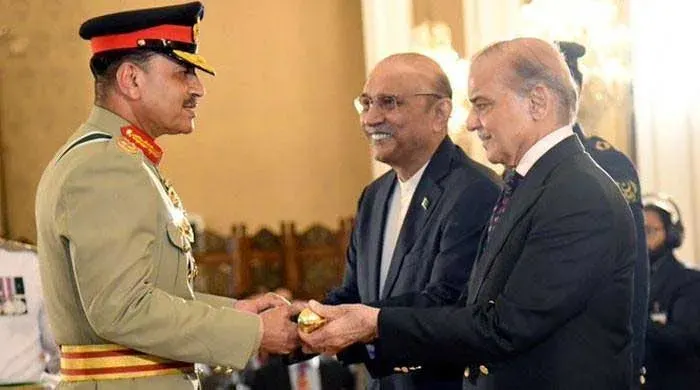
Two days after the cabinet decision, a special investiture ceremony was held at Aiwan-e-Sadr in Islamabad.
President Asif Ali Zardari and Prime Minister Shehbaz Sharif jointly conferred the baton of Field Marshal upon Syed Asim Munir.
The ceremony was attended by senior political and military leaders, including former Prime Minister Nawaz Sharif, Pakistan Peoples Party Chairman Bilawal Bhutto Zardari, federal ministers, provincial chief ministers, governors and the chiefs of the armed services.
The presence of leaders from different political institutions gave the ceremony considerable national significance.
President Zardari praised Munir's military career and leadership during the recent confrontation.
Prime Minister Shehbaz Sharif described the military response as a major achievement and paid tribute to the armed forces.
The ceremony also honoured the contributions of the Pakistan Air Force, Navy and other personnel involved in defending the country.
The baton itself symbolised the exceptional distinction associated with the Field Marshal rank.
For Munir, the moment represented the culmination of nearly four decades of military service, from his commissioning in 1986 to the highest rank in the Pakistan Army.
President of Pakistan+1
An honour dedicated to the nation
Munir's response to the promotion was notable for its emphasis on collective service.
In a statement released by Inter-Services Public Relations, he expressed gratitude to the president, prime minister and federal cabinet for their confidence.
He dedicated the honour to Pakistan's armed forces, veterans, martyrs and the people of the country.
Rather than presenting the distinction as a personal achievement alone, he described it as recognition of the sacrifices and contributions of the military institution and the nation.
This message reflected an important principle of military leadership.
No major military operation is conducted by a single commander.
Successful defence depends on the combined efforts of soldiers, airmen, sailors, intelligence personnel, planners, logistics specialists and civilian authorities.
See#22 Page7