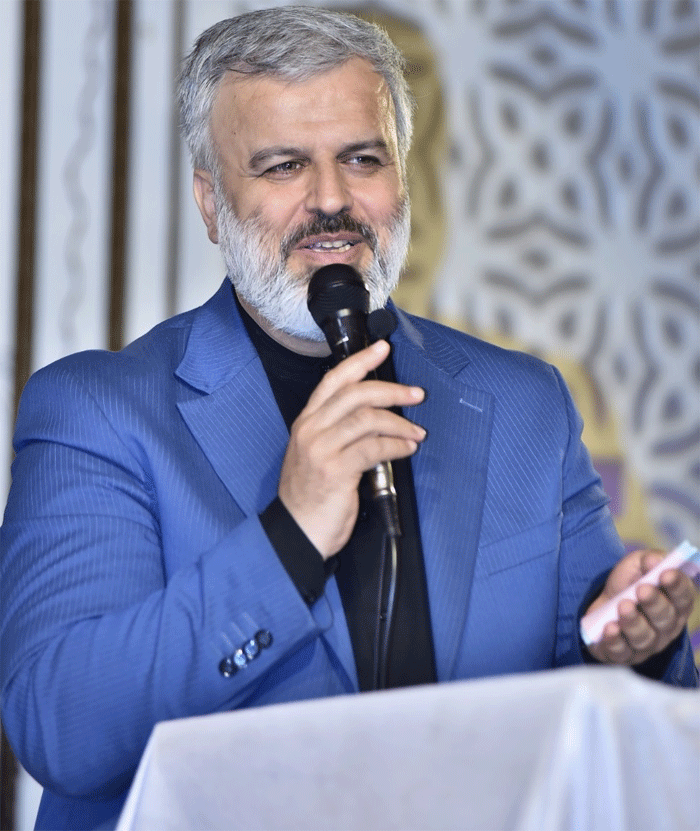
As Dr. Saeed Talebi Nia, Director General of the Iranian Cultural Centre (ICC), Karachi, prepares to leave Pakistan after completing four years of distinguished service, his departure brings with it a profound sense of appreciation as well as sadness among those who had the privilege of working and interacting with him.
Goodbyes are never easy, particularly when they are said to a friend who has devoted years to bringing two brotherly nations and their peoples closer together. We bid farewell to Dr. Talebi Nia with heavy hearts, but also with gratitude for the contribution he has made towards strengthening Pakistan-Iran cultural relations and promoting greater understanding between the peoples of the two countries.
During his four-year tenure in Karachi, Dr. Talebi Nia proved himself to be one of the most active and dynamic directors of the Iranian Cultural Centre. He did not regard cultural diplomacy as something confined to formal ceremonies or official meetings. Instead, he transformed it into continuous engagement with Pakistani society.
Under his leadership, the Iranian Cultural Centre organized numerous memorable programmes, seminars, conferences, literary gatherings, cultural events, exhibitions and intellectual interactions. These initiatives brought together journalists, writers, academics, scholars, students, artists and representatives of different sections of society.
Through these activities, audiences in Karachi were provided opportunities to understand Iran beyond contemporary headlines – its ancient civilization, literature, poetry, art, intellectual traditions and the deep historical and cultural connections that bind Iran and Pakistan.
Indeed, Pakistan and Iran share much more than a border. Persian language and literature have profoundly influenced the cultural and intellectual heritage of the subcontinent. Allama Muhammad Iqbal’s extraordinary association with Persian poetry itself represents an enduring intellectual bridge between our peoples. Dr. Talebi Nia understood these historical connections and consistently sought to bring them into contemporary cultural engagement.
One of his particular qualities was his accessibility. He maintained close interaction with journalists, editors, intellectuals and cultural personalities and encouraged dialogue rather than merely ceremonial engagement. This personal approach helped the Iranian Cultural Centre develop meaningful relationships with different segments of Pakistani society.
For me personally, one of the most memorable initiatives undertaken during his tenure was the opportunity he provided to a four-member Pakistani delegation to visit the Islamic Republic of Iran.
The delegation comprised myself, Nazir Leghari, Owais Rabbani and Zain Naqvi. During our seven-day visit, we travelled to Tehran, Qom and Isfahan, gaining first-hand exposure to Iranian society, culture, history and development.
The visit was far more than an ordinary journey abroad. It provided us with an opportunity to experience Iran ourselves rather than understand it only through news reports and international narratives.
Tehran presented the face of a modern and vibrant Iranian society; Qom provided insight into Iran’s religious and scholarly traditions; while Isfahan, with its magnificent architecture and extraordinary cultural heritage, demonstrated the depth of Persian civilization.
Such people-to-people exchanges have lasting significance. A journalist or intellectual who visits another country, meets its people and observes its society first-hand returns with an understanding that cannot be acquired through official documents or second-hand accounts. By facilitating this delegation, Dr. Talebi Nia contributed directly to deeper understanding between Pakistani media professionals and Iranian society.
This was also representative of his broader philosophy during his tenure: relations between countries become stronger when relations between their people become stronger.
Pakistan and Iran are neighbours connected by geography, history, faith, culture and centuries of interaction. At different moments, regional and international developments may create new challenges, but the foundations of Pakistan-Iran friendship remain deep. Cultural diplomacy has an important role in protecting and strengthening those foundations.
Institutions such as the Iranian Cultural Centre therefore perform a responsibility that goes considerably beyond organizing cultural functions. They create spaces where misconceptions can be addressed, dialogue can flourish and younger generations can discover the historical connections between their societies.
Dr. Talebi Nia performed this responsibility with energy, commitment and sincerity.
Perhaps one of the best measures of a diplomat or cultural representative’s success is not simply the number of events organized during his tenure, but the relationships and memories he leaves behind. On that measure, Dr. Talebi Nia’s four years in Karachi have been highly productive.
He leaves behind numerous friends in Pakistan and particularly in Karachi’s journalistic, academic and cultural circles. The programmes organized during his tenure, the discussions he encouraged and the personal relationships he cultivated will remain part of his contribution to Pakistan-Iran friendship.
As he prepares to return to Iran, there will naturally be sadness among his friends and associates in Karachi. Yet there should equally be satisfaction that his tenure produced meaningful results and contributed towards bringing the two brotherly countries closer.
Positions change and assignments eventually come to an end, but sincere friendships survive official tenures.
We therefore say goodbye to Dr. Saeed Talebi Nia with heavy hearts, while expressing our sincere appreciation for his four years of meritorious service and his tireless efforts to promote cultural understanding and strengthen Pakistan-Iran relations.
We wish him success, good health and happiness in the next chapter of his professional and personal journey. Wherever his future responsibilities may take him, we hope he will continue to serve as a friend of Pakistan and an advocate of stronger relations between our two countries.
Goodbye, Dr. Saeed Talebi Nia. Karachi will remember your warmth, your friendship and your contribution. You may be leaving Pakistan, but the bridges of friendship you helped build will remain.