
PART IX - From Riyadh to the Gulf: Asim Munir and Pakistan's Expanding Strategic Partnership with Saudi Arabia
When General Syed Asim Munir assumed command of the Pakistan Army in November 2022, one of his earliest diplomatic priorities was a relationship that had occupied a special place in Pakistan's foreign and security policy for decades.
Saudi Arabia.
For Pakistan, the Kingdom was more than an important Middle Eastern country. It was a longstanding defence partner, a source of economic assistance and investment, a major destination for Pakistani workers and the custodian of Islam's two holiest mosques.
For Saudi Arabia, Pakistan represented a country with substantial military capabilities, experienced armed forces and a history of defence cooperation.
The relationship had survived regional conflicts, changing governments and shifting international alliances.
Yet the years following Munir's appointment would witness an important transformation.
What had traditionally been a close but largely bilateral defence relationship would evolve into a more formal strategic-security partnership.
At the centre of this development stood the Strategic Mutual Defence Agreement signed by Pakistan and Saudi Arabia on September 17, 2025.
The agreement marked a significant development in the security architecture connecting South Asia and the Gulf.
For Munir, whose military career had included service in Saudi Arabia, it also represented another stage in his increasingly visible role in Pakistan's international strategic diplomacy.
A relationship rooted in history
Pakistan and Saudi Arabia have maintained close relations since the early years of Pakistan's independence.
Religion, cultural affinity and shared diplomatic interests provided an important foundation.
But the relationship developed well beyond these connections.
Pakistan contributed to the training of Saudi military personnel and maintained defence cooperation with the Kingdom over several decades.
Saudi Arabia, meanwhile, became an important source of financial support for Pakistan during periods of economic difficulty.
Millions of Pakistanis found employment in Saudi Arabia and other Gulf countries, sending remittances that became a major source of foreign exchange for their families and the national economy.
The relationship therefore developed along several interconnected dimensions: defence, diplomacy, labour, investment, trade and economic assistance.
For Pakistan's military leadership, Saudi Arabia had long been one of the most important destinations for strategic engagement.
General Munir was no stranger to that relationship.
Earlier in his military career, he had served with a Pakistani training contingent in Saudi Arabia.
That experience gave him professional familiarity with the Kingdom's military environment, although the precise influence of those earlier connections on subsequent diplomatic decisions cannot be independently established.
January 2023: The first overseas journey
Only weeks after becoming Army Chief, Munir chose Saudi Arabia and the United Arab Emirates for his first official overseas visit.
The journey began in January 2023, when Pakistan was facing a severe economic crisis.
Foreign-exchange reserves were under pressure.
Inflation was rising.
The government was struggling to secure external financing and restore investor confidence.
The Army Chief's visit was officially focused on bilateral relations, military-to-military cooperation and security matters.
But its wider significance was difficult to ignore.
Pakistan's traditional Gulf partners were also among the countries whose financial support could help Islamabad navigate its economic difficulties.
On January 9, Munir met Saudi Crown Prince and Prime Minister Mohammed bin Salman at his winter camp in AlUla.
The meeting covered bilateral relations and matters of mutual concern.
Munir also held discussions with Saudi Defence Minister Prince Khalid bin Salman.
The meetings reinforced a longstanding pattern: Pakistan's defence relationship with Saudi Arabia remained an important component of the broader political partnership.
For Munir, the AlUla engagement represented his first major personal interaction with the Saudi Crown Prince after becoming Army Chief.
dawn.com+1
From military cooperation to strategic confidence
The relationship continued developing during 2023 and 2024.
Pakistan's military and Saudi defence authorities maintained regular contacts concerning training, cooperation and regional security.
On March 23, 2024, Saudi Defence Minister Prince Khalid bin Salman met General Munir in Islamabad.
According to the Saudi Press Agency, their discussions focused on the longstanding relationship, the strategic defence partnership and opportunities to develop cooperation further.
They also exchanged views on regional and international matters.
The meeting was another indication that both countries wanted to move beyond traditional defence exchanges towards a more comprehensive strategic relationship.
Yet the changing Middle Eastern environment was creating additional challenges.
The Gaza conflict had intensified regional tensions.
Iran's relations with several regional actors remained strategically sensitive.
The security of maritime routes, energy infrastructure and Gulf states had become an increasingly important international concern.
Pakistan therefore faced a delicate task.
It wanted to strengthen its relationship with Saudi Arabia without becoming unnecessarily entangled in regional rivalries.
It also needed to maintain working relations with Iran, its immediate neighbour.
For Munir, military diplomacy required balancing these interests rather than treating every regional relationship in isolation.
Saudi Press Agency
The economic dimension: From assistance to investment
Saudi Arabia's importance to Pakistan was not confined to defence.
The Kingdom had repeatedly supported Pakistan during financial difficulties through deposits, oil-related facilities and other forms of assistance.
But by 2023 and 2024, Islamabad increasingly sought a different model.
Pakistan wanted to attract long-term investment rather than remain dependent on emergency financial support.
The Special Investment Facilitation Council, established in June 2023, became a central mechanism for this effort.
Agriculture, mining, energy, information technology and infrastructure were identified as priority sectors.
Saudi Arabia was among the most important potential investors.
In October 2024, a Saudi business delegation led by Investment Minister Khalid al-Falih visited Pakistan.
The visit produced 27 memoranda of understanding valued at approximately $2 billion, covering sectors including energy, agriculture, technology, mining and industry.
Prime Minister Shehbaz Sharif and General Munir attended the signing ceremony.
The presence of both civilian and military leadership reflected the government's broader effort to provide institutional support for investment.
However, the distinction between investment announcements and actual capital flows remained important.
Memoranda of understanding do not automatically translate into completed projects.
The real test would be implementation, transparency, commercial viability and the creation of productive economic activity.
AP News
September 2025: A historic defence agreement
The most consequential development came on September 17, 2025.
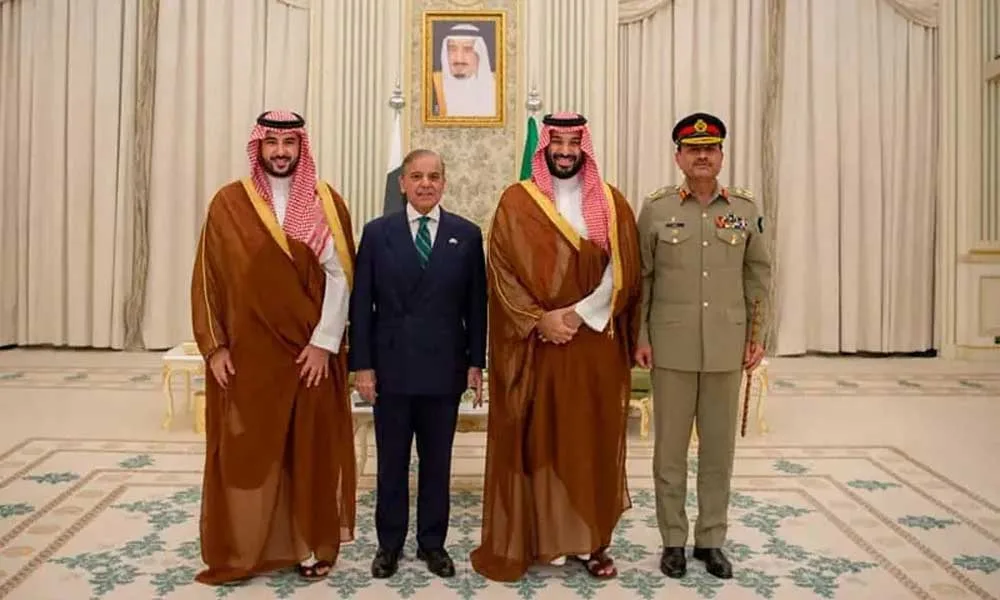
Prime Minister Shehbaz Sharif travelled to Riyadh, where he was received by Crown Prince Mohammed bin Salman at Al-Yamamah Palace.
Following official discussions, the two leaders signed the Strategic Mutual Defence Agreement.
Field Marshal Asim Munir accompanied the Pakistani leadership during the visit.
The agreement formalised a commitment of exceptional strategic significance.
According to the joint statement issued by both governments, aggression against either country would be considered aggression against both.
The agreement was intended to strengthen defence cooperation and joint deterrence.
Its significance extended beyond Pakistan and Saudi Arabia.
For decades, both countries had maintained close military ties, but the new agreement introduced a more explicit framework of mutual defence.
It also connected the security interests of a major South Asian military power with those of one of the Middle East's most influential states.
For Pakistan, the agreement demonstrated the strategic value of its defence capabilities and longstanding relationship with Riyadh.
For Saudi Arabia, it represented another element in its evolving regional-security arrangements.
For Munir, the agreement marked an important development in the strategic environment in which he was operating.
Saudi Press Agency+2
What the agreement means - and what remains unclear
The central provision of the agreement was straightforward.
An attack against either country would be treated as an attack against both.
But the precise operational implications were less clear.
The full text and detailed implementation arrangements were not publicly disclosed.
Consequently, questions remained about the procedures for consultation, the nature of military assistance and the circumstances in which specific obligations might be activated.
International analysts also debated the implications for Pakistan's nuclear deterrent.
Pakistan is a nuclear-armed state, while Saudi Arabia possesses substantial conventional military capabilities and advanced defence relationships with several countries.
However, the publicly released agreement did not establish an automatic Pakistani nuclear-security guarantee for Saudi Arabia.
Claims about such an arrangement require evidence beyond the official joint statement.
The agreement was therefore best understood as a significant formalisation of mutual defence commitments, with important operational details remaining undisclosed.
Its effectiveness would ultimately depend on how the two governments interpreted and implemented those commitments.
The UAE: Another pillar of Gulf diplomacy
While Saudi Arabia occupied a particularly prominent position, Pakistan's Gulf diplomacy was never limited to Riyadh.
The United Arab Emirates remained another indispensable partner.
The UAE hosted a large Pakistani expatriate community and maintained extensive economic, commercial and investment ties with Islamabad.
In February 2025, General Munir accompanied Prime Minister Shehbaz Sharif during a meeting with UAE President Sheikh Mohamed bin Zayed Al Nahyan in Abu Dhabi.
The discussions covered economic cooperation, investment, development and regional developments.
In June 2025, following the India-Pakistan military confrontation, Munir-by then a Field Marshal-again accompanied the Prime Minister during a meeting with the UAE President.
Pakistan publicly appreciated the UAE's role in efforts to defuse the crisis.
These engagements illustrated how Gulf relationships increasingly connected defence cooperation, investment and regional diplomacy.
Pakistan Identifier Database+1
The process continued in February 2026, when Munir met Sheikh Tahnoon bin Zayed Al Nahyan, the UAE's National Security Adviser and Deputy Ruler of Abu Dhabi.
Their discussions included security, investment, economic cooperation and regional stability.
Munir reaffirmed the importance of the UAE's security and stability to Pakistan, while acknowledging the Emirates' longstanding economic support.
Radio Pakistan
2026: The defence pact faces a regional crisis
The significance of the Saudi-Pakistan agreement became especially apparent in 2026, as conflict involving Iran, Israel and the United States spread across the Middle East.
The escalation presented Islamabad with a difficult strategic dilemma.
Pakistan had made a formal mutual-defence commitment to Saudi Arabia.
But Iran was also Pakistan's neighbour, with which it shared a long border and important political, religious and economic interests.
An uncontrolled confrontation could threaten Pakistan's security, regional trade and diplomatic relationships.
In February 2026, Munir met Saudi Defence Minister Prince Khalid bin Salman in Riyadh, reaffirming the strategic defence partnership.
In March, as the regional crisis intensified, the two held further consultations concerning attacks affecting Saudi Arabia and measures to prevent additional escalation.
Pakistan's public position combined support for Saudi security with appeals for restraint and a peaceful settlement.
This balance was significant.
The mutual-defence agreement strengthened Pakistan's obligations towards Saudi Arabia, but Islamabad also had strong reasons to avoid a wider regional war.
On March 12, Prime Minister Shehbaz Sharif met Crown Prince Mohammed bin Salman in Jeddah, accompanied by Munir.
The Pakistani leadership reaffirmed solidarity with Saudi Arabia while emphasising the importance of regional peace and stability.
These developments demonstrated that the September 2025 agreement was no longer merely a diplomatic document.
It had become part of the practical framework through which the two countries consulted during a major regional-security crisis.
Saudi Press Agency+2
Between Saudi Arabia and Iran
For Pakistan, one of the most difficult aspects of Gulf diplomacy has always been maintaining constructive relations with both Saudi Arabia and Iran.
Saudi Arabia is a major economic and defence partner.
Iran is an immediate neighbour.
Pakistan cannot ignore either relationship.
The two countries have their own regional interests, political differences and security concerns.
Pakistan's national interest therefore lies in preventing regional competition from developing into a confrontation that damages its own security.
This required careful diplomacy from the civilian government and measured engagement from the military leadership.
Munir's involvement in Saudi defence consultations reflected the military dimension of Pakistan's commitments.
But the wider task of preventing regional escalation depended on diplomatic engagement led by the government and foreign ministry.
The distinction between military cooperation and foreign-policy decision-making remained essential.
A strong defence partnership could contribute to deterrence.
But durable peace would require negotiations, restraint and political settlements.
A soldier's changing diplomatic responsibilities
By late 2026, Asim Munir's engagement with Saudi Arabia and the Gulf had developed substantially beyond his first overseas visit as Army Chief.
In January 2023, he travelled to Riyadh as a newly appointed military commander.
By September 2025, he was accompanying Pakistan's civilian leadership during the signing of a landmark mutual-defence agreement.
By 2026, he was participating in consultations concerning the security implications of an expanding Middle Eastern conflict.
These developments reflected the changing responsibilities of Pakistan's senior military leadership.
The Army Chief was no longer concerned only with conventional military preparedness and internal counterterrorism.
His institutional responsibilities increasingly intersected with international security partnerships, defence diplomacy, economic confidence and regional crisis management.
Yet it would be misleading to attribute Pakistan's Gulf relationships to one individual.
They were built over generations through the contributions of successive governments, diplomats, military commanders, business communities and millions of Pakistani expatriates.
Munir's significance lay in the role he played during a period when these relationships were acquiring new strategic dimensions.
The next challenge: South Asia's most dangerous rivalry
Pakistan's relationships with China, Saudi Arabia and the UAE provided important diplomatic and strategic support.
But none of these partnerships could eliminate the country's most enduring conventional security challenge.
India.
Since independence, the two nuclear-armed neighbours had experienced wars, military confrontations, border crises and recurring diplomatic breakdowns.
The unresolved Kashmir dispute remained a central source of tension.
For Pakistan's Army Chief, the relationship with India required constant attention.
In May 2025, that responsibility would become immediate and extraordinarily serious.
A terrorist attack in Indian-administered Kashmir, competing accusations, cross-border military strikes and retaliatory operations brought the two countries into their most dangerous direct confrontation in years.
The crisis would test Munir's military leadership and Pakistan's diplomatic relationships simultaneously.
It would also become the immediate background to his elevation to the rank of Field Marshal.
After examining his expanding Gulf diplomacy, the next chapter turns to the confrontation that transformed his public and institutional standing. (To be continued)