


TFD NEWS
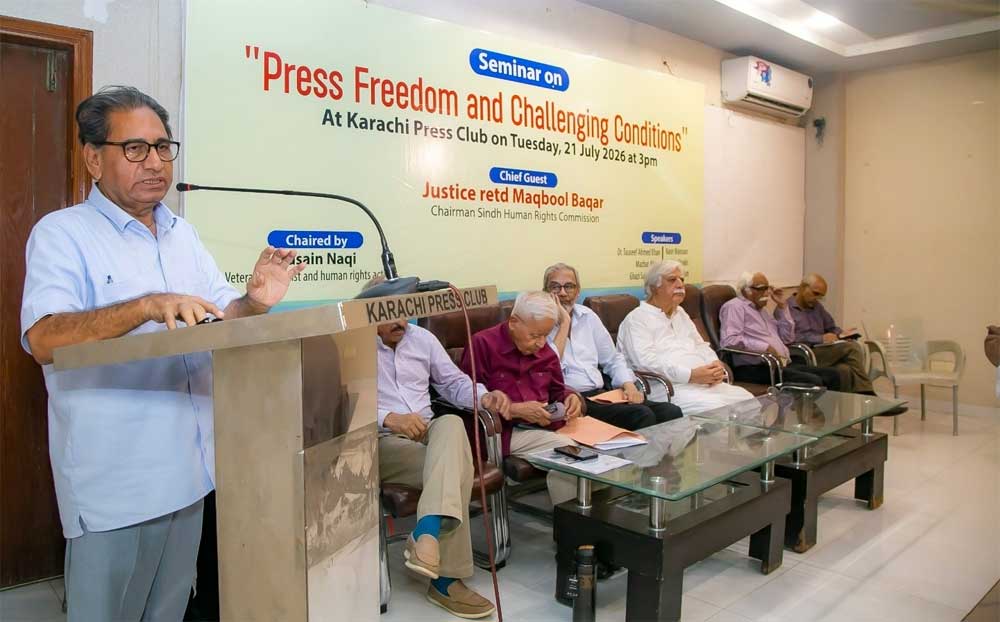
KARACHI: Speakers at a seminar on Tuesday called for greater unity among journalists, trade unions and human rights organisations to resist what they described as growing restrictions on civil liberties, freedom of expression and democratic rights in Pakistan.
The seminar, titled “Press Freedom and Challenging Conditions,” was jointly organised by the Karachi Union of Journalists (KUJ), the National Trade Union Federation (NTUF) and The Knowledge Forum (TKF) at the Karachi Press Club.
Participants said the country’s media environment had become increasingly difficult, with journalists facing threats to their livelihoods, legal restrictions and growing pressure on independent reporting.
They also expressed concern over shrinking civic space and restrictions on political activities and peaceful protests.
The chief guest, Justice (Retd) Maqbool Baqar, Chairperson of the Sindh Human Rights Commission, said the Constitution of Pakistan guaranteed fundamental rights to every citizen, including freedom of expression, association and peaceful assembly.
He stressed that constitutional rights must be protected and upheld in accordance with the law and democratic principles.
Chairperson of the Human Rights Commission of Pakistan (HRCP) Asad Iqbal Butt said press freedom was under threat across the country and many journalists were working under constant fear of losing their jobs.
Veteran journalist Husain Naqi deplored that media is restricted severely as they are not allowed to cover people’s movements in Balochistan and Azad Jamu and Kashmir.
He said this era is much worse than the Marial Laws period. He regretted that
He said the prevailing environment had made it increasingly difficult for journalists to perform their professional duties independently. Calling for stronger protection of freedom of expression, he demanded the withdrawal of the Prevention of Electronic Crimes Act (PECA), arguing that the law had adversely affected freedom of the press.
Senior journalist Dr Tauseef Ahmed Khan also addressed the gathering and highlighted the importance of protecting press freedom and democratic values.
In Balochistan, he said many journalists have lost their lives because they were covering atrocities against citizens and enforced disappearance.
Senior journalist Mazhar Abbas said the country was passing through one of its most difficult periods and warned that restrictions on free expression continued to increase.
Referring to the enactment of PECA, Abbas said he had earlier warned government ministers that the law could eventually be used against those who introduced it. He said such legislation had created an environment where freedom of expression was increasingly under pressure.
He also expressed disappointment over what he described as the limited role being played by lawyers’ organisations. He said the legal community had played a historic role during the 2007 lawyers’ movement and under previous military governments, but was no longer demonstrating the same level of resistance in defence of constitutional rights.
Abbas said journalists were also facing severe economic hardships because of worsening employment conditions and financial insecurity within the media industry.
He stressed that journalists and trade unions should strengthen their cooperation and launch a joint struggle to protect democratic freedoms and labour rights.
Commenting on state institutions, Abbas said both Parliament and the judiciary had become ineffective and had failed to adequately defend constitutional freedoms.
Secretary General of NTUF Nasir Mansoor highlighted labour rights issues and alleged that employers were depriving workers of billions of rupees by failing to pay legally mandated wages.
He said many factories and business establishments were not implementing the minimum wage fixed by the government, resulting in widespread exploitation of workers. He called for stricter enforcement of labour laws and greater accountability of employers.
Senior educationist Dr Riaz Sheikh said the country was passing through a difficult phase in which democratic space was shrinking.
He said civil society activists were increasingly finding it difficult to organise peaceful demonstrations or even hold press conferences inside or outside press clubs.
Dr Sheikh referred to the recent incident involving noted human rights and women’s rights activist Sheema Kermani, who was detained outside the Karachi Press Club, and described it as an example of the restrictions being faced by civil society activists.
The seminar concluded with participants emphasising that journalists, labour organisations and human rights groups needed to build stronger alliances to defend constitutional freedoms and democratic values.
They maintained that protecting press freedom was essential for safeguarding democracy, transparency and accountability, and urged all democratic forces to work together to ensure that citizens’ fundamental rights, including freedom of expression and peaceful political activity, were fully respected.
KUJ President Tahir Hassan Khan criticised the functioning of journalists’ protection commissions, saying that although such bodies had been established by the government, they were being controlled by the bureaucracy instead of operating independently.
He said journalists’ protection commissions should be made autonomous so they could effectively safeguard media workers and address violations against journalists without administrative interference.

)