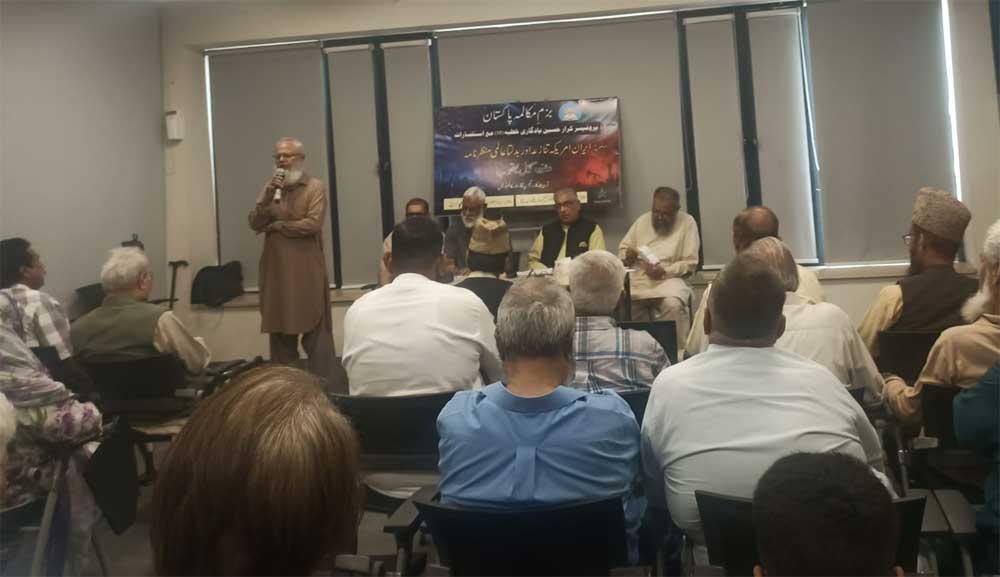
KARACHI: Bazm-e-Mukalma Karachi organized another thought-provoking session aimed at promoting informed dialogue and critical thinking. The forum regularly brings together renowned scholars, intellectuals, educationists, and analysts to discuss important national and international issues. Following the keynote address, participants-comprising prominent figures from Karachi’s literary, academic, and social organizations-engage in an interactive question-and-answer session, allowing for a comprehensive exploration of the topic and encouraging meaningful exchange of ideas.
The session held on July 19 focused on “The Iran-United States Conflict and Its Impact on the Global Landscape.” The keynote speaker, noted columnist and political analyst Mr. Sohail Yaqoob, delivered an informative presentation, explaining the historical, political, and geopolitical dimensions of the Iran-US relationship in a clear and accessible manner.
He traced Iran’s history from the Muslim conquest under Hazrat Saad ibn Abi Waqqas (RA) through the Abbasid era, the Safavid and Qajar dynasties, and the rule of Mohammad Reza Pahlavi and his son, Reza Shah Pahlavi. He highlighted the significance of Iran’s oil resources, explaining that British companies once retained approximately 75% of the oil revenues while Iran received only 25% in royalties. He noted that Prime Minister Mohammad Mossadegh nationalized Iran’s oil industry, leading to tensions with Britain, after which the United States supported the restoration and strengthening of the Pahlavi monarchy.
Mr. Yaqoob also discussed Ayatollah Khomeini’s exile in Najaf and later France before leading the Islamic Revolution in Iran. He explained the establishment of the office of the Supreme Leader and the creation of the Islamic Revolutionary Guard Corps (IRGC), resulting in a dual power structure alongside Iran’s regular armed forces.
Providing broader historical context, he stated that the First World War led to the collapse of the Ottoman Caliphate and the emergence of new states in the Middle East. Following the Second World War, the decline of British influence paved the way for the independence of countries such as Pakistan and India, while institutions including the United Nations, NATO, and the World Bank reshaped the post-war international order. He further discussed the Cold War, the rivalry between the United States and the Soviet Union, and America’s emergence as the sole superpower after the Soviet collapse.
Discussing the current Iran-US tensions, Mr. Yaqoob argued that prolonged sanctions and restrictions on Iran contributed to escalating hostilities. He reviewed the foreign policies of various US administrations, including Henry Kissinger’s diplomatic outreach to China and the Camp David Accords under Egyptian President Anwar Sadat. He also expressed the view that President Donald Trump’s policies strongly favored Israel, further intensifying regional tensions.
According to the speaker, Iran received varying degrees of support from China, North Korea, and Russia, which has discouraged further military escalation by both the United States and Israel. He also expressed concern that if the conflict were to expand into a third world war, it could significantly alter the geopolitical landscape of the Middle East, affecting countries such as Qatar, Kuwait, Bahrain, and the United Arab Emirates.
Commenting on Pakistan, he appreciated the country’s balanced diplomatic approach and constructive role in mediation. However, he stressed that stronger domestic governance and greater public welfare are essential for long-term national stability. He emphasized that governments become truly strong when they empower and improve the lives of their people. He also highlighted the need for long-term infrastructure projects, including water and oil pipelines, to address issues in Karachi and Balochistan.
Following the lecture, an engaging question-and-answer session was held, during which participants sought clarification on various aspects of the discussion. The event was attended by writers, journalists, academics, and prominent social figures.
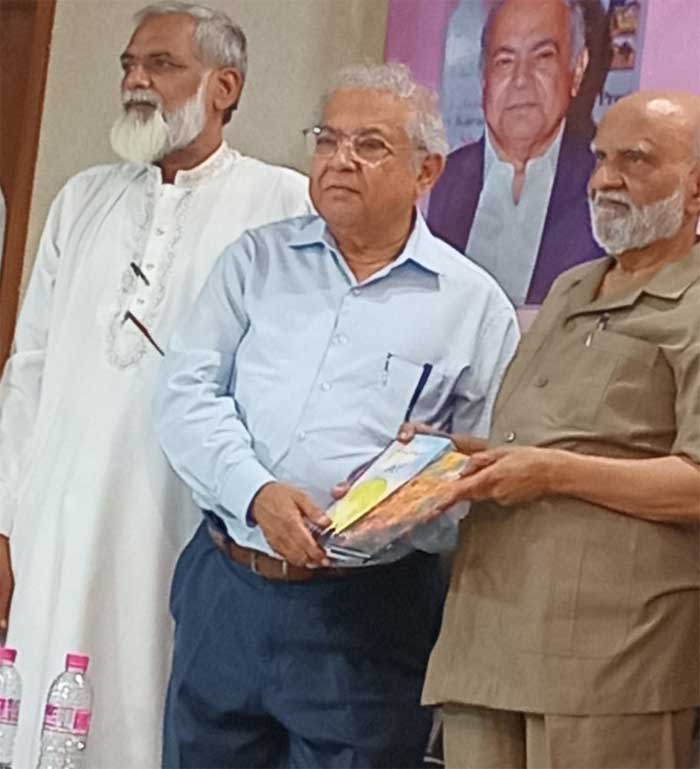
In keeping with the tradition of Bazm-e-Mukalma Karachi, the session concluded with the presentation of a commemorative shield to the guest speaker by Tariq Jamil, Shafiq Ismail, and Nasir Shamsi.
Note: This is an improved English translation of the report. Some geopolitical statements reflect the speaker’s views as presented during the session and should not be interpreted as established facts.
Bazm-e-Mukalma Karachi discusses the Iran-US conflict and its global implications
Previous article
Next article