Part II: From three gorges to Sindh - lessons in water, energy and long-term planning

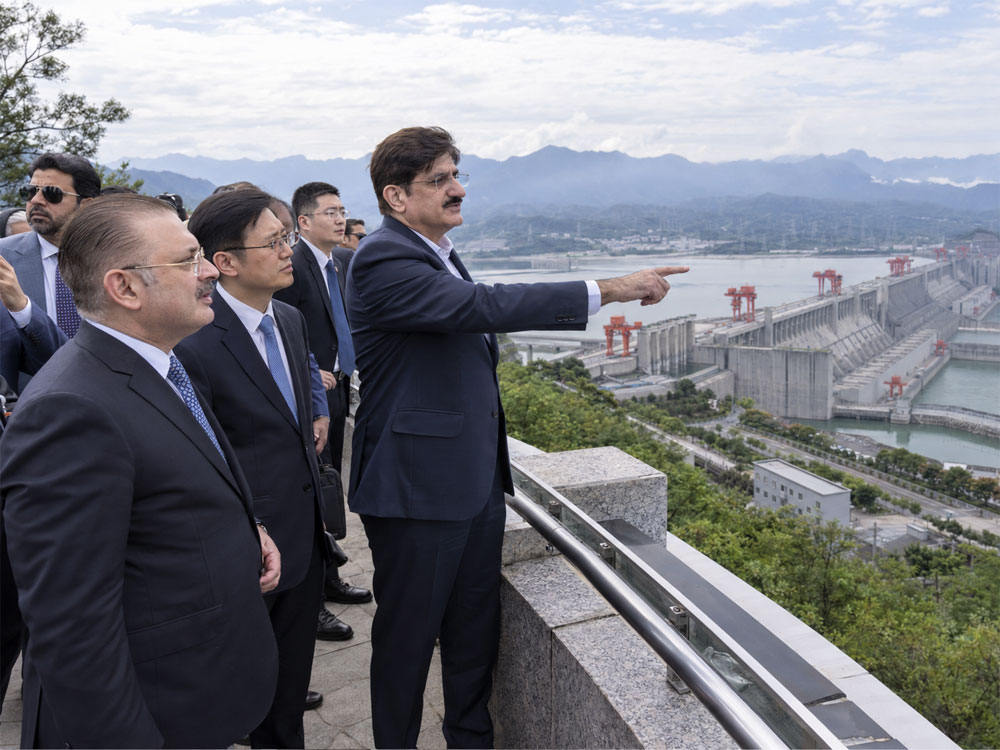
Chief Minister Sindh Syed Murad Ali Shah's visit to the Three Gorges Dam during his week-long China mission was more than an encounter with one of the world's most remarkable engineering projects. For Sindh, a province struggling simultaneously with floods, water shortages, irrigation pressures, growing energy demand and climate-related challenges, the visit offered a powerful lesson in how long-term planning can transform natural resources into economic strength.
The Three Gorges visit formed one of the earliest important engagements of the Sindh delegation's China programme. According to the official itinerary, the delegation visited and received a briefing at the project before proceeding towards Wuhan for the next stage of the mission.
Murad Ali Shah was accompanied during the China mission by Senior Minister Sharjeel Inam Memon, members of the provincial cabinet, senior officials and Wang Zhaoxiang, Secretary to the Consul General at the Chinese Consulate in Karachi. Their presence gave the visit political, administrative and institutional continuity as the delegation examined different aspects of China's development experience.
The importance of Three Gorges for Sindh lies not in copying the project itself, but in understanding the philosophy behind it.
Water as a development asset
Sindh's relationship with water is complicated.
The province depends heavily on the Indus River for agriculture, drinking water, industry and the broader rural economy. Yet every year the same province may face severe shortages in one season and destructive flooding in another.
This contradiction demands more than short-term responses.
China's water infrastructure demonstrates how a country can treat water not merely as a natural resource but as a strategic national asset requiring long-term planning, scientific management, engineering expertise and institutional coordination.
For Sindh, this approach is particularly relevant.
The province must ask whether its existing water systems are designed to meet the needs of the next several decades. Are irrigation networks efficient enough? Is floodwater being treated only as a disaster, or can part of it be managed and used more productively? Are urban water systems prepared for Karachi's expanding population? Can modern monitoring, forecasting and data analysis reduce losses and improve distribution?
These questions are more important than simply admiring the scale of Three Gorges.
Floods and shortages - two sides of one problem
Recent years have demonstrated Sindh's vulnerability to extreme weather.
Heavy monsoon rainfall can overwhelm drainage and irrigation infrastructure, destroy crops and displace communities. Yet when rainfall decreases, farmers in several areas face severe water shortages.
Climate change is making both extremes more difficult to manage.
A major lesson from China is that flood control, water storage, irrigation, energy and environmental planning cannot be treated as separate policy areas. They must form part of one integrated water strategy.
For Sindh, this could mean stronger flood forecasting, improved drainage, rehabilitation of irrigation channels, better management of barrages, water conservation and increased use of technology to monitor flows in real time.
The objective should be to move from emergency response towards anticipatory water management.
Instead of waiting for floods and then responding to them, planning should identify vulnerable areas, improve drainage before disaster strikes and develop systems capable of using available water more efficiently.
Energy and water must be planned together
The Three Gorges experience also underlines the connection between water and energy.
Sindh's own development strategy cannot separate energy policy from industrial and agricultural planning.
The concept note prepared for the China visit identified energy as a major area of cooperation, including Thar coal, renewable energy, fertilizer, smart grids and energy solutions for industrial zones. It also highlighted the province's wind and solar potential alongside its conventional energy resources.
Sindh is in a unique position.
It has coal in Thar, one of Pakistan's strongest wind corridors in Jhimpir and Gharo, substantial solar potential and major industrial demand concentrated around Karachi and other urban centres.
The challenge is to integrate these resources.
Industrial zones require reliable electricity. Agriculture needs energy for irrigation and cold storage. Cities need power for water pumping, transport and digital infrastructure. Future data centres and technology parks will require dependable energy supplies.
The Chinese lesson is therefore not simply to produce more electricity, but to plan energy according to the wider development needs of the economy.
Long-term projects require continuity
Perhaps the most important lesson of Three Gorges is not engineering at all.
It is continuity.
Major infrastructure projects cannot be planned according to electoral cycles. They require institutions capable of carrying forward projects over many years, despite changes in governments, personalities or short-term political priorities.
This remains one of Pakistan's recurring development challenges.
Too often projects are announced with great enthusiasm, only to slow down because of bureaucratic delays, funding problems, policy changes or shifting political priorities.
Sindh needs a stronger culture of continuity.
Once a major project is approved on sound economic, environmental and technical grounds, implementation should proceed according to clearly defined milestones. Progress should be publicly monitored, delays explained and responsibility fixed.
Development cannot remain dependent on ceremonial inaugurations. It requires institutional discipline.
Technology can transform water governance
The China visit also demonstrated how closely modern infrastructure is linked with technology.
The delegation's engagements in Wuhan later focused on artificial intelligence, data systems, digital governance and smart-city management. This technological dimension should also be applied to Sindh's water sector.
Sensors, satellite data, weather forecasting, digital mapping and artificial intelligence can help government agencies monitor rainfall, river flows, irrigation requirements, drainage conditions and flood threats.
For Karachi, technology could improve storm-water management and provide early warnings before heavy rainfall.
For rural Sindh, better data could help regulate irrigation distribution, identify water losses and improve crop planning.
This would represent an important shift from traditional infrastructure management towards smart infrastructure management.
Thar mine water: turning a challenge into an opportunity
Another interesting element in the Sindh-China investment framework concerned the productive use of mine dewatering water from Thar.
The concept note specifically identified possibilities for using mine water for agriculture and climate-smart irrigation.
This is precisely the type of integrated thinking Sindh needs.
An industrial activity creates a water-management challenge. Instead of treating that water only as waste, research can determine whether it can support agriculture, environmental rehabilitation or other productive uses after appropriate treatment.
The approach reflects a broader principle: development projects should create multiple benefits wherever possible.
From observation to implementation
Murad Ali Shah's visit to Three Gorges will have lasting significance only if the lessons observed there lead to policy changes at home.
Sindh should consider establishing a comprehensive water and infrastructure planning framework bringing together irrigation, agriculture, energy, local government, disaster management, environment and urban planning authorities.
The purpose should not be to create another committee, but to ensure that major decisions are coordinated.
Chinese technical cooperation could also be explored in water monitoring, flood forecasting, irrigation efficiency, renewable-energy integration and engineering training.
Young Sindhi engineers should be given opportunities to study Chinese water and infrastructure systems, while universities could develop joint research programmes with Chinese institutions.
Knowledge transfer may ultimately prove as valuable as physical investment.
A lesson larger than the dam
The greatest lesson from Three Gorges is not the size of the concrete structure, the turbines or the scale of electricity generation.
It is the idea that development requires the ability to think decades ahead.
Sindh's water problems, energy shortages, urban expansion and climate challenges cannot be resolved through temporary measures. They require a long-term provincial vision supported by scientific planning, modern technology, consistent financing and institutional continuity.
Murad Ali Shah's China mission has provided an opportunity to observe how another country confronted enormous development challenges through planning and execution.
Sindh must now decide how much of that discipline it is prepared to adopt.
If the Three Gorges experience encourages the province to treat water, energy and infrastructure as interconnected pillars of economic development, the visit will have achieved something far more important than a ceremonial tour of a famous dam.
It will have helped introduce a new way of thinking about Sindh's future.