Part V: Karachi and Shanghai - Can Pakistan's Largest City Learn from China's Global Metropolis?

Among the many comparisons inspired by Chief Minister Sindh Syed Murad Ali Shah's week-long visit to China, perhaps none is more compelling than the contrast between Karachi and Shanghai.
Both are major port cities. Both occupy strategic positions on important maritime routes. Both have historically served as commercial gateways for their wider regions.
Yet their contemporary development paths are dramatically different.
Shanghai has emerged as one of the world's great financial, industrial and technological centres, supported by modern transport, efficient ports, extensive urban infrastructure and long-term planning. Karachi, despite its enormous economic importance, continues to struggle with transport, water, drainage, waste management, congestion and fragmented urban governance.
Murad Ali Shah's Shanghai engagements therefore raised a significant question: what can Karachi learn from Shanghai without attempting to imitate it blindly?
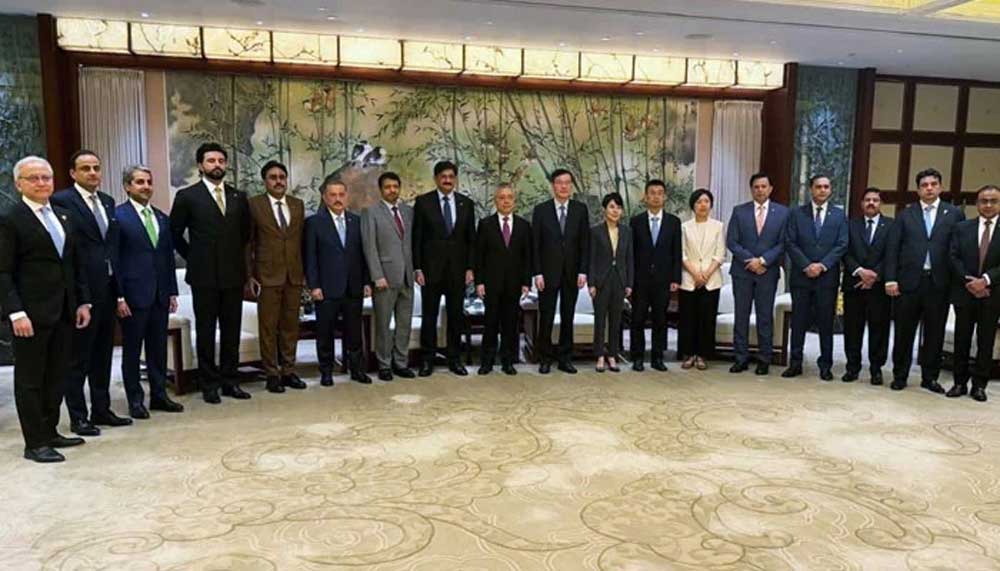
The Chief Minister was accompanied during the China mission by Senior Minister Sharjeel Inam Memon, members of the provincial cabinet, senior officials and Wang Zhaoxiang, Secretary to the Consul General at the Chinese Consulate in Karachi.
The delegation's visit to Shanghai included investment, technology and urban-development engagements, while the city also hosted the Sindh Investment Conference, which became the economic centrepiece of the mission.
Two port cities, very different outcomes
Karachi has many of the natural advantages that helped great commercial cities prosper.
It has a major coastline, large ports, a huge consumer market, Pakistan's principal financial institutions and extensive industrial activity.
But natural advantage alone does not create a global city.
Shanghai demonstrates what happens when ports, industry, transport, finance, housing, public spaces, technology and urban planning are coordinated over decades.
Karachi's challenge is precisely the opposite: too many important systems operate separately.
Transport planning may not align with housing development. Industrial expansion can take place without corresponding infrastructure. Drainage and road construction are often treated independently. Multiple government agencies operate across the same city.
The first lesson from Shanghai is therefore not about skyscrapers.
It is about coordination.
Ports must connect with the wider economy
Karachi Port and Port Qasim give Sindh enormous strategic value.
The China-visit concept note itself emphasised Karachi's maritime access to the Middle East, Africa and Central Asia and identified logistics and supply-chain development as major opportunities.
But the economic value of a port depends on what happens behind it.
Containers must move quickly to factories and warehouses. Exporters need predictable customs procedures. Industrial areas need reliable transport links.
Shanghai's development shows how port infrastructure can become the foundation of a much larger manufacturing and logistics ecosystem.
Karachi should adopt the same principle.
Dhabeji, Port Qasim, Karachi's industrial areas, highways and future freight networks should be planned as parts of one economic corridor rather than isolated assets.
This could reduce logistics costs and make Sindh more attractive to international manufacturers.
Public transport must become central
Shanghai's mass-transit system is one of the most visible symbols of its urban transformation.
Karachi, by contrast, still depends heavily on private cars, motorcycles and fragmented transport services.
Recent improvements in bus services are welcome, but the city's scale requires a much more integrated system.
Bus rapid transit, rail-based transport, feeder routes and digital ticketing should eventually operate as a connected network.
Transport is not only a mobility issue.
It affects productivity, employment, education and quality of life.
A worker who spends several hours travelling each day loses time and income. Businesses also face higher costs when employees and goods cannot move efficiently.
The lesson from Shanghai is that public transport must be treated as economic infrastructure.
Waterfront development with public purpose
Shanghai has also demonstrated how waterfront areas can become valuable economic and civic spaces.
Karachi possesses one of Pakistan's greatest natural assets: its coastline.
Yet much of the city's waterfront remains underdeveloped, inaccessible or poorly integrated into urban planning.
Karachi should explore how selected waterfront areas can be developed for recreation, tourism and commercial activity while preserving environmental and public interests.
This does not mean copying Shanghai's famous Bund.
Karachi needs its own waterfront identity.
But the principle remains valuable: a coastline should contribute to the quality and economic life of a city rather than remain disconnected from it.
Urban planning must think decades ahead
Perhaps the largest difference between Karachi and Shanghai lies in long-term planning.
Karachi's population has expanded far faster than its infrastructure.
Housing spreads outward, roads become congested and public services attempt to catch up after development has already occurred.
This pattern is expensive and unsustainable.
A modern Karachi strategy should identify where the city is expected to grow over the next twenty or thirty years and build infrastructure accordingly.
Transport corridors, drainage, water supply, schools, hospitals and industrial areas should be planned before population pressures become overwhelming.
This requires institutions capable of thinking beyond annual budgets and political cycles.
The Chinese development experience repeatedly demonstrates the importance of planning infrastructure in advance of demand.
See#24 Page7