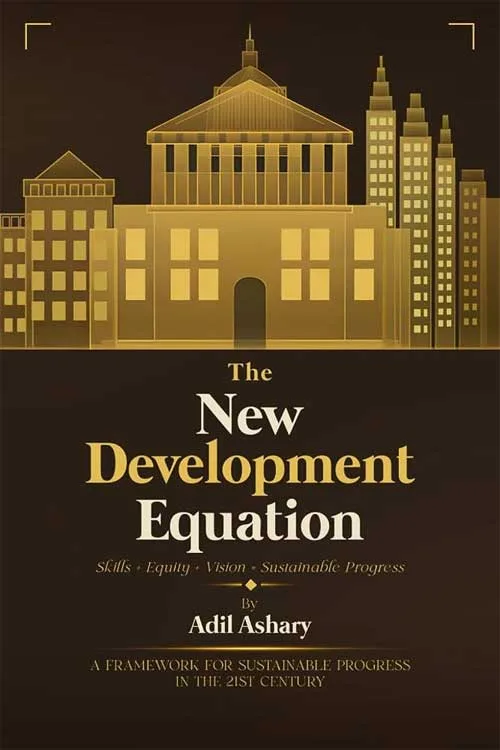
The new equation he developed goes like:
Skills +Equality +Vision = Sustainable Progress
He developed the frame work for Sustainable Progress in the 21st Century.
He raises a very valid question, "Why does human progress cluster so unevenly across the planet? Why do the world's most developed nations, such as Sweden, Germany, Japan and Canada seem to rise in colder regions, while the poorer or politically fragile ones stretch across warmer belts, such as sub Saharan Africa, South Asia or the equatorial tropics? Was this simply geography's accident or nature's design?
From here the author's journey took off to find the answer his curiosity landed him at many places. (Read many development indicators)
The book is is very diligently divided into eight parts, meaning eight scenarios of development being discussed in search of his initial query.
Part 1 and 2 discusses very important issue, that is, Human Development: History & Review and Essentials of Human Development in 21st century.
The author rightfully founded the new development equation as:
Skills + Equity + Vision = Sustainable Progress
Author's viewpoint is the above equation is not a slogan but take it as a diagnostic framework.
In today's world Skill is the game changer .This one indicater in the world of AI, digital literacy, critical thinking and creativity is the key to success. Old schooling methods will soon wipe out. Degrees won't matter but Skills do.
Part 111 discusses major economies. Such as United Kingdom, Italy, Japan, Germany, United States China Russia and India.
Followed by the case studies in part 1V.
Important events as turnaround of countries.
Part V touches the most important issue of.
Foundations of Human Survival.
The list include all nesassities one need to survive, such as, food security, clean drinking water, sanitation, health and ways to protect from natural disasters.
Part V1 once again important. Analysing technology and Energy, most challenging issues. Technology advancing on daily basis and energy crisis affect industrial production.
Part V11 Here author examines the variables he used in the new Development Equation. All discussion in the book is based on these variables.
Sustainable Progress depends upon Skills, Equity and Vision. He argued about the foundational education in schools. Today the old schooling methods of Rote Learning are becoming redundant at a fast pace, in China and Japan already teaching methods have changed. In the whole world homeschooling is advancing.
Practical skills are the requirement.
Part V111 threw light on Strategic Vision and Synthesis. Question put here is about the leadership countries need at this point. Toolkit alone cannot do justice. One need a leader with a vision and second tier of the government who can practically implement successfully the vision designed by the leader. As China did under the leadership of Mao Zedong and Chua En Lai
Singapore did under Lee Kuan yew
Malaysia did under Mahathitr Mohammad
Now, see the difference between old and new equation.
The old equation is simple:
Development = GDP Growth
If GDP increases, say 6 or 7 % imply country is developing.
If GDP decline to 2 or 3 % imply country is failing cetaris peribus, a Latin phrase meaning, other things remaining constant...here it says keeping other Development indicaters constant or ignored. Pakistan followed the above formula for quite seven decades chasing GDP growth rate,thought
Development =f (GDP) alone
It was observed at times even when GDP grew to 6 % but poverty, illiteracy numbers didn't decline. Economists, disapproved the old equation.
Now follow the new Development equation by World Bank, UNDP and Noble Winners. It is:
Real Development = (Economic Growth + Human Capability + Social Inclusion) × Sustainability / Inequality
In the above equation inequality indicator is argued by the author and it's absolutely the case.
Development is not only GDP Growth or raising income or wealth of only few , letting the population number below poverty line increase , or the number of out of the school children increase ...this should not be considered as Development.
Famous Macroeconomic equation:
y= C+I + G+(X-M)
Y = GDP
If Y increases, time to celebrate
During 1960's Dr Mehboobul Haq followed this, but it was he who then said," We have learned to grow, but not to distribute".
Pointing towards inequality. It was the time when major portion of wealth greater then 60 % owned by 22 families. Unequal distribution of wealth leave other Development indicaters unchanged. A common man remain as poor as before the GDP Growth was less.
Development not seen as it should be.
New development equation introduced here by the author is:
Skills + Equity + Vision = Sustainability
Equity is important among all in the country.Atleast one should be able to see some improvement in his living standard.
When Equity is practiced, development seen at all segments of society.
Hence, development is not the function of GDP
Development = f (GDP)
But function of Skills, Equity and Vision, only then sustainable development be achieved. A leader must have the vision of Mao Zedong, Lee kuan yew and Mahathir Mohammad.
The book has tables, maps, line graphs, bar graphs and more, neatly prepared and placed where required.
Another unique feature of the book is the frame in which References are planned. Not 100 references in alphabetical order but the author very diligently divided the references chapter wise. For a researcher access become super easy if need to consult a perticular reference material for any specific chapter for more clearlification or learning.
This book will definitely benefit first of all the Educationists, teachers and researchers both.
Planning personal, policy makers, development practitioners and also I would like to add social right activists, who often talk about female inclusion in the workforce and free education for children atleast in rural areas of the country.
The book due to it's originality inspirational to young minds who aim to become researcher.
" The New Development Equation ", is a book a reader ones start reading will not lose interest till the end. Written in a very simple language, no mathematical equations in the text, so readers don't be misguided by the title of the book.
I hope readers will enjoy reading as much as I did.
I congratulate the author Adil Ashary for writing this valuable book that will convince the reader to ponder.
I conclude with the final note:
The assundering dedication to his nephews, stayed at the back of my mind during reading the book and writing this review. I am sure that the world left by Azhar Zaidi and Ali Zaidi ( May they Rest in Eternal Peace ) will become a heaven on earth if the author Adil Ashary keeps showering his pristine and sublime thought process for his readers in times to come.