

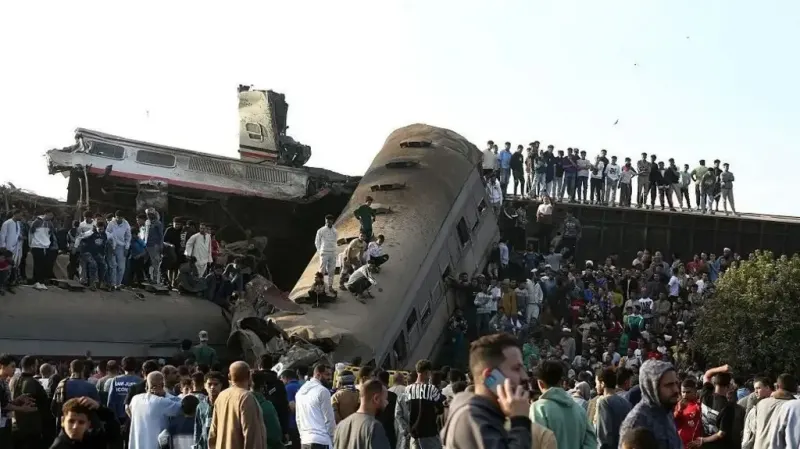
CAIRO: At least seven people were killed and more than 112 others injured when two passenger trains collided near Cairo on Sunday, causing one of the trains to derail and prompting a major emergency response in Egypt's Giza province.
According to Egyptian authorities, the accident occurred in the al-Ayyat district when a train travelling between Giza and Fayoum struck the rear of another passenger train operating on the Cairo-Aswan route.
The impact caused the second train to leave the tracks and derail onto a nearby rural road, leaving passengers injured and disrupting railway operations in the area.
Egypt's Ministry of Health confirmed the casualties, while emergency response teams were immediately mobilised to assist survivors and transport the injured to nearby medical facilities.
More than 70 ambulances were deployed to the accident site as rescue personnel worked to evacuate passengers and provide emergency medical assistance. Those requiring further treatment were transferred to hospitals in the surrounding districts.
Egyptian National Railways said rescue crews, technical teams and heavy cranes had been dispatched to remove damaged railway carriages, clear debris and restore train operations as quickly as possible.
The collision has once again drawn attention to safety concerns surrounding Egypt's extensive railway network, which serves millions of passengers and remains an essential mode of transportation across the country.
The al-Ayyat district has previously witnessed several deadly railway accidents, including one of the worst disasters in Egypt's transport history.
In February 2002, a devastating fire aboard a passenger train travelling south of Cairo claimed more than 370 lives. The area was also the scene of further fatal railway collisions in 2009.
With a population exceeding 110 million, Egypt relies heavily on rail transportation for daily commuting and long-distance travel. Its railway system is among the largest in Africa, but ageing infrastructure and operational challenges have repeatedly raised concerns about passenger safety.
Although the Egyptian government has invested billions of dollars in transport development over the past decade, including highway expansion and modern high-speed railway projects, substantial sections of the conventional railway system still require upgrades.
The latest collision highlights the continuing importance of railway safety improvements, effective signalling systems, infrastructure maintenance and stronger operational oversight.
Authorities were continuing efforts to clear the accident site and restore normal railway services.
Source attribution: This news report has been rewritten and adapted for The Financial Daily from information reported by Al Jazeera, with reference to statements from Egypt's Ministry of Health and Egyptian National Railways. The casualty figures and circumstances reflect the information available in the source report and may be subject to revision.