


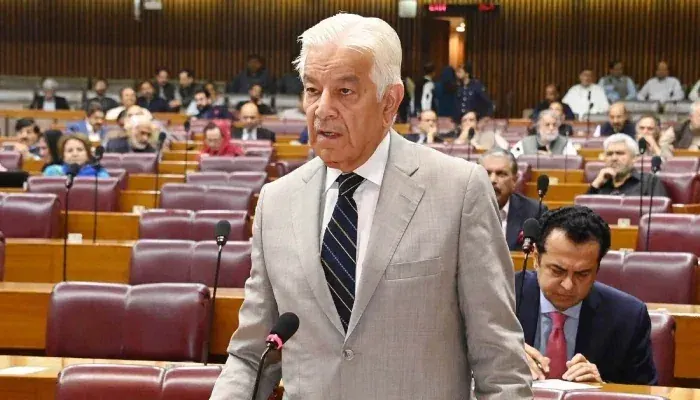
SIALKOT: Defence Minister Khawaja Muhammad Asif has expressed support for the creation of additional provinces in Pakistan, suggesting that the country could be reorganised into as many as 12 administrative units to improve governance, decentralise authority and ensure more effective delivery of public services.
Speaking to Geo News in Sialkot on Sunday, the defence minister emphasised that any decision to establish new provinces should be based strictly on administrative requirements rather than ethnic, linguistic or political considerations.
He maintained that Pakistan's growing population and increasingly complex governance challenges required a comprehensive review of the existing provincial administrative structure.
Asif said discussions regarding the creation of new provinces had been taking place for approximately two months, with different proposals and opinions emerging from political and public circles across the country.
Expressing his willingness to consider a larger number of provinces, he argued that the central objective should be improved administration and public welfare rather than the preservation of existing political arrangements.
The defence minister questioned the concentration of administrative and financial authority in major provincial capitals, including Lahore, Karachi, Peshawar and Quetta, saying that such centralisation often prevented effective governance at the grassroots level.
He advocated transferring administrative responsibilities and decision-making powers to smaller units, enabling authorities to respond more efficiently to local development needs and public concerns.
According to Asif, the existing system of financial distribution also requires reconsideration, particularly regarding the transfer of resources from the federal government to provincial administrations.
He observed that funds allocated to provinces frequently remained under the control of provincial governments, while local government institutions continued to depend on provincial authorities for their financial and administrative requirements.
The minister argued that greater financial autonomy and stronger local government institutions were essential for ensuring that development resources reached communities where they were most needed.
He also acknowledged the reluctance of political leaders to relinquish authority, pointing out that the concentration of power remained a significant obstacle to administrative reform.
Asif stressed that political authority should be regarded as a public responsibility rather than a personal privilege, urging elected representatives to support institutional arrangements that strengthen governance and accountability.
Referring to Pakistan's constitutional and administrative history, he recalled the controversial One Unit scheme, under which the provinces of West Pakistan were merged into a single administrative entity before the arrangement was eventually abolished.
He also referred to Afghanistan's provincial structure as an example of administrative reorganisation, suggesting that countries could increase the number of administrative units in response to changing governance requirements.
The defence minister's remarks come amid renewed debate over a possible restructuring of Pakistan's provincial boundaries.
According to a report published by The News, a proposal to divide the country into 12 provinces is reportedly under consideration, potentially involving a nationwide referendum and a constitutional amendment.
Under the reported proposal, Punjab could be divided into four provinces, Khyber Pakhtunkhwa and Balochistan into three provinces each, and Sindh into two administrative units.
The report suggested that the proposed changes could be pursued through a possible 28th Constitutional Amendment, with discussions potentially advancing during the first half of 2027.
Preparatory steps could reportedly begin in the first quarter of next year, although no official decision has been announced regarding the proposed boundaries, administrative arrangements or timetable for implementation.
Any formal creation of new provinces would require compliance with Pakistan's constitutional procedures, including the provisions governing amendments affecting provincial boundaries.
Under Article 239(4) of the Constitution, an amendment altering the limits of a province must also receive the support of at least two-thirds of the total membership of the assembly of the province concerned.
Political observers believe that creating additional provinces could have far-reaching implications for Pakistan's administrative structure, financial resource distribution, political representation and development planning.
Supporters of smaller provinces argue that decentralisation could improve access to government institutions, reduce administrative delays and promote more balanced regional development.
However, any such initiative would also require extensive political consultation, constitutional consensus and careful consideration of administrative costs, institutional capacity and regional sensitivities.
The latest statement by the defence minister has brought renewed attention to a longstanding debate over whether Pakistan's existing provincial structure adequately serves the needs of its expanding population.
While proposals for additional provinces have surfaced repeatedly in the country's political history, the present discussion appears to place particular emphasis on administrative efficiency, financial decentralisation and strengthening governance closer to the people.
For now, the proposal remains at the discussion stage, with no formally approved plan for creating 12 provinces or introducing the reported constitutional amendment.
Source attribution: This report has been independently rewritten and adapted for The Financial Daily, based on Khawaja Asif's remarks originally reported by Geo News and information regarding the proposed 12-province arrangement published by The News International. Additional constitutional context has been included for readers.