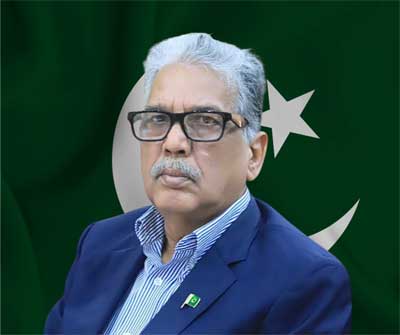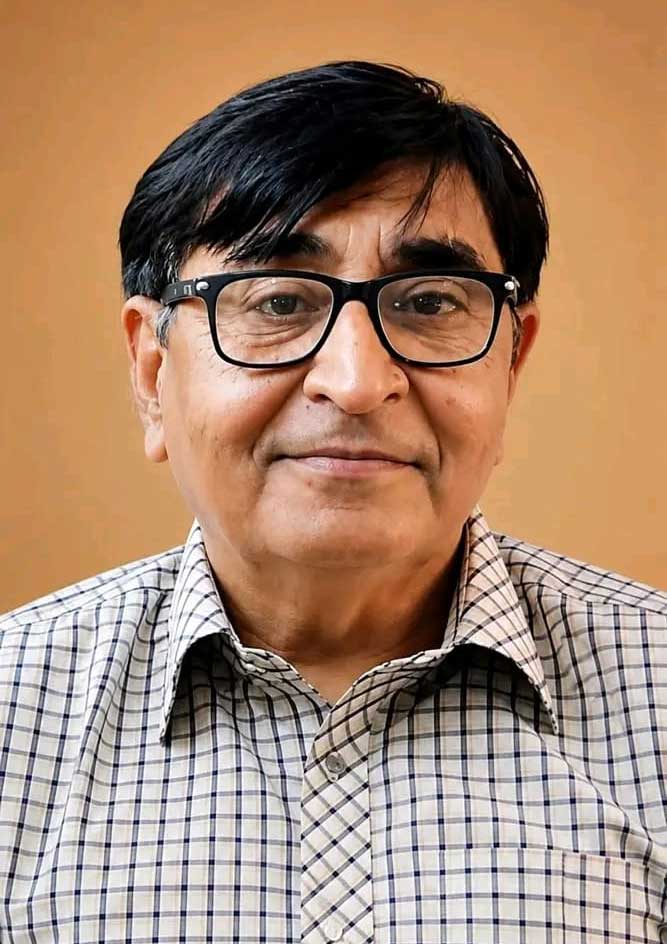
There are departures that leave behind silence, and there are departures that make us listen more carefully to the voice that has gone. The passing of Asad Jafri, the distinguished Urdu poet, satirist, educationist and man of letters, belongs to the latter category. With his death, Urdu literature has lost a distinctive voice-one that could make people smile while quietly asking them to think, laugh at human contradictions while exposing social absurdities, and transform the ordinary incidents of life into memorable literary observations.
Asad Jafri passed away in Lahore in August 2026 at the age of 91 after a prolonged illness. His death was mourned by literary, educational and social circles as the loss of a respected personality whose life had been devoted to education, literature and the cultural life of Pakistan.
But the death of a poet is never merely the end of a biological life. A poet continues to exist in language-in remembered verses, in books on shelves, in laughter shared by readers, and in those moments when an old line suddenly seems to describe the present more accurately than yesterday’s newspaper.
Asad Jafri was born on June 3, 1935, in Darya Khan, Bhakkar, to Ghulam Hussain Jafri, a schoolteacher. His early years and education shaped a personality in which learning and observation remained inseparable. He received his schooling in Vehari and later graduated from Government Emerson College, Multan. His professional career was equally distinguished. In 1961 he became headmaster of Municipal Committee High School, Bhakkar, where he served until 1985. He subsequently served as District Education Officer in Bhakkar until 1990.
This combination of educator and poet is important to understanding his literary personality. The classroom gave him an intimate understanding of human behaviour; literature gave him the language with which to interpret it. He observed society not from an ivory tower but from close range-from schools, streets, homes, institutions and everyday conversations.
His greatest literary distinction lay in satire and humour. Yet to describe Asad Jafri simply as a humorous poet would be to underestimate him. Behind humour there was observation; behind observation there was criticism; and behind criticism there was an unmistakable concern for society.
The finest satire does not merely make us laugh. It makes us uncomfortable after the laughter ends.
That quality was visible in his poetry. His satirical qitaat appeared in collections including Khanda Nawazi and Tera Hansna Qayamat Hai, while Qindeel-e-Jaan reflected another dimension of his poetic expression. He also wrote songs for Pakistani films and composed sehras, rukhsatis and nohas, demonstrating the breadth of his literary engagement.
His literary world was not confined to one mood or one genre. He could move from the serious to the comic, from the intimate to the social, and from traditional poetic expression to popular cultural forms.
Perhaps that is one reason his poetry remains accessible.
Asad Jafri understood that humour is not the opposite of seriousness. Sometimes humour is the most serious language available to a writer.
In his famous poem “Main Shair Hoon”, the poet adopts the voice of a literary figure who is simultaneously celebrated and neglected. The poem is funny on the surface, but beneath its wit lies a poignant commentary on the social and economic condition of the poet. He writes of being called an artist and a connoisseur of beauty, while ironically lamenting the practical poverty that often accompanies literary recognition.
This is characteristic of his genius: he could turn personal frustration into collective satire.
He knew the strange fate of the poet in society-the poet is invited to speak, applauded for his words, perhaps even praised as a custodian of culture, but is not always given the dignity that his intellectual labour deserves.
That contradiction remains relevant.
Indeed, perhaps more relevant today than ever.
The modern literary world is full of ceremonies, conferences, awards, photographs and speeches about literature. Yet the fundamental question remains: do we genuinely value the people who create literature?
Asad Jafri’s humour quietly forces us to confront that question.
His satire also possessed a remarkable ability to discover the extraordinary in the ordinary. His poem “Murgh-e-Marhoom”, for example, takes the apparently trivial subject of a deceased rooster and transforms it into an elaborate comic lament. The poem is amusing precisely because it treats an ordinary domestic loss with the emotional vocabulary normally reserved for great tragedies.
But beneath the comedy is a deeper literary lesson.
A poet does not necessarily require grand historical events to create poetry. Sometimes a household, a neighbour, a quarrel, a television set, a vehicle, a family relationship or even a rooster can become material for literature-provided the writer possesses the eye to see it.
Asad Jafri possessed that eye.
His poetry frequently employed exaggeration, irony and everyday speech to reveal the absurdities of social life. His humour was therefore not detached from reality; it was deeply rooted in it.
This is why his work deserves to be remembered not merely as humorous verse but as a record of social observation.
He was also a bridge between different cultural worlds. His songs for Pakistani cinema connected literary expression with popular entertainment, while his traditional compositions connected him with older Urdu literary and cultural traditions. His ability to move between these worlds reflected the versatility of a writer who refused to confine himself to a single literary identity.
Yet perhaps the most enduring aspect of Asad Jafri’s legacy is not any single poem or book. It is the temperament behind his writing.
He belonged to a generation for whom literature was not simply content. It was a way of seeing.
The poet watched society, absorbed its contradictions and returned them to society in a transformed form. Sometimes he returned them as a ghazal. Sometimes as satire. Sometimes as a joke. Sometimes as a song.
And sometimes, most powerfully, as laughter.
The death of an elderly poet inevitably invites us to reflect on mortality. Ninety-one years is a long journey, but for literature even a century is insufficient. The poet always leaves unfinished conversations. There are books yet to be read, verses yet to be rediscovered, meanings yet to be interpreted.
That is the strange consolation of literature.
The human being disappears; the sentence remains.
The voice becomes memory; the words become inheritance.
Asad Jafri’s passing therefore should not be seen only as the conclusion of a life. It should be regarded as an invitation to revisit that life and its literary contribution. His work deserves to be read by a new generation-not simply for entertainment, but for its insight into the human condition.
In an age increasingly dominated by hurried communication, artificial laughter and fleeting digital attention, there is something profoundly valuable in the work of a poet who could spend time observing ordinary life and extracting from it a literary truth.
His humour reminds us not to take our social pretensions too seriously.
His satire reminds us that laughter can carry criticism.
His poetry reminds us that language remains capable of converting the commonplace into art.
And his life as an educationist reminds us that literature and learning are not separate worlds. Both are ultimately concerned with enlarging the human mind.
Asad Jafri has now entered the territory about which every poet writes but no poet can completely understand: absence.
His chair will remain empty.
His familiar voice will no longer be heard in the same gatherings.
The generation that knew him personally will gradually become smaller.
But Urdu has a long memory.
It remembers those who enriched it.
It remembers those who made it laugh.
It remembers those who used words not merely to decorate reality but to reveal it.
Asad Jafri belongs to that tradition.
Perhaps the most fitting tribute to him is therefore not excessive mourning but continued reading. Let his books remain open. Let his verses be recited. Let his satire be understood beyond the laughter. Let young readers discover the craft behind his simplicity.
For a poet, remembrance is not carved in marble.
It is carried by the reader.
And as long as someone opens a page of Asad Jafri, smiles at his wit, pauses at his observation and recognises in his words a fragment of society-or perhaps a fragment of himself-the poet has not entirely left us.
He has merely changed his address.
He now lives where poets ultimately belong.