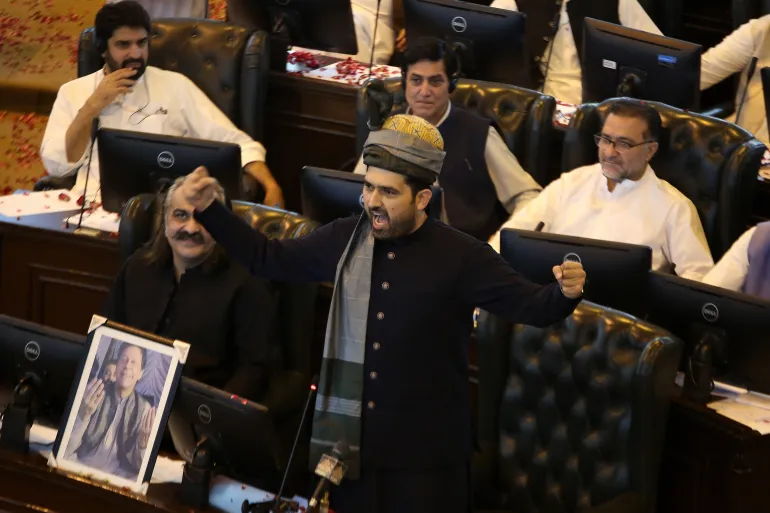
ISLAMABAD: Khyber Pakhtunkhwa Chief Minister Sohail Afridi has emerged as a central figure in Pakistan Tehreek-e-Insaf’s latest campaign seeking the release of jailed former prime minister Imran Khan, with the 37-year-old preparing to lead a major march towards Islamabad on October 4.
The planned protest was initially scheduled for September 27 but was postponed amid road closures, arrests and heightened security measures. Afridi has said the delay was a political decision rather than a retreat and has maintained that the march will proceed. Recent reporting confirms the protest was rescheduled for October 4. Al Jazeera
Afridi, one of the youngest chief ministers in Khyber Pakhtunkhwa’s history and the first from the province’s former tribal districts to hold the office, has increasingly become PTI’s most visible elected figure in the absence of Khan.
Khan has been imprisoned since August 2023 and is serving sentences arising from multiple cases. He and PTI have maintained that the cases against him are politically motivated. Al Jazeera
From Provincial Leader to National Mobiliser
Afridi’s rise represents a significant transformation for a politician who entered the Khyber Pakhtunkhwa Assembly after the February 2024 general elections.
Born in Bara in Khyber district, Afridi came through PTI’s student and youth organisations before entering electoral politics. He was elected chief minister in October 2025, succeeding Ali Amin Gandapur.
Since assuming office, Afridi has attempted to combine his responsibilities as provincial chief executive with an increasingly prominent role in PTI’s national political campaign.
That dual role has become particularly visible in recent weeks as he has travelled outside Khyber Pakhtunkhwa to mobilise supporters for the movement demanding Khan’s release.
The campaign has also intensified tensions between PTI and the federal government. Authorities imposed restrictions and closed major routes ahead of the originally scheduled protest, while Islamabad and Punjab introduced measures restricting public gatherings. The Islamabad-Peshawar M-1 motorway and GT Road were subsequently reopened after the march was postponed. Al Jazeera
Government, PTI Trade Accusations
The federal government has portrayed the mobilisation as a potential law-and-order challenge, while PTI insists its campaign is intended to remain peaceful.
Information Minister Attaullah Tarar has criticised PTI’s protest strategy, while Interior Minister Mohsin Naqvi has indicated that authorities will not permit a prolonged disruption of the capital. Afridi, for his part, has said protesters would march without weapons and has publicly urged supporters to remain peaceful. Al Jazeera
The political confrontation intensified further following the detention of Khan’s sisters ahead of the previously planned Islamabad march. PTI has also alleged widespread arrests of its lawmakers and workers. Government representatives have said preventive measures were necessary to maintain public order. Al Jazeera
Afridi has simultaneously indicated that PTI remains open to dialogue with the federal government, even as preparations continue for the October 4 mobilisation. UA.News
Challenge of Leading PTI Without Khan
Afridi’s growing profile comes as PTI continues to operate without its founder directly managing the party’s day-to-day political activities.
Although Barrister Gohar Ali Khan remains PTI chairman and other senior office-bearers continue in their positions, Afridi’s control of the Khyber Pakhtunkhwa government gives him resources and a political platform that distinguish him from many other party leaders.
His challenge is not limited to mobilising supporters. As chief minister, he also faces pressure to address security, governance and development issues in Khyber Pakhtunkhwa, a province that has experienced repeated militant attacks and displacement linked to security operations. Afridi has publicly opposed large-scale military operations and advocated a different approach to militancy. Al Jazeera
Whether the October 4 mobilisation changes Khan’s legal or political circumstances will depend on factors beyond Afridi’s control, including court proceedings, government decisions and any political negotiations. The march nevertheless represents a major test of Afridi’s ability to mobilise PTI supporters while simultaneously managing Pakistan’s most security-challenged province.
For PTI, the immediate objective is clear: maintain political pressure for Khan’s release and demonstrate that the party retains substantial mobilisation capacity despite its founder’s imprisonment.
For Afridi, the October 4 march could further define his expanding role within PTI — from provincial chief minister to one of the principal public faces of the party’s campaign surrounding Khan.