

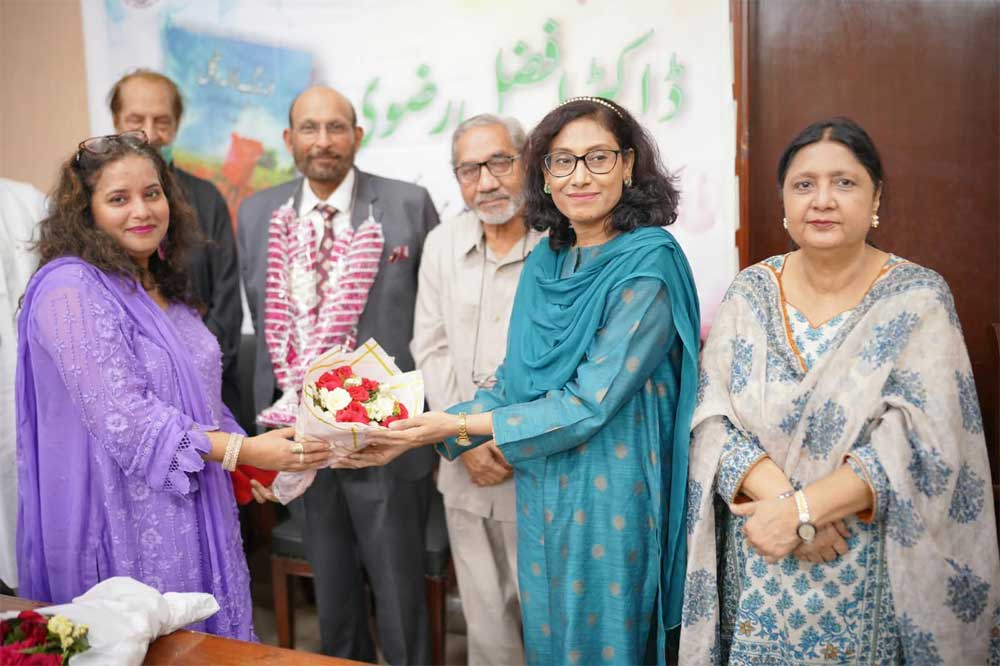
KARACHI: A distinguished gathering of the city’s prominent figures attended the launch and introduction ceremony of Dr. Afzal Rizvi’s book, Dar-e-Barg-e-Lala-o-Gul (Volume III)-a research work focusing on botanical elements in Iqbal’s poetry. The event was organized by the Muhibban-e-Bhopal Forum in collaboration with the Urdu Dictionary Board. Professor Sahar Ansari presided over the ceremony, while Professor Dr. Moinuddin Aqeel attended as the chief guest. Speakers included Professor Dr. Raees Samdani, Professor Seema Naz, Dr. Nuzhat Anees, Syed Nasir Ali, and Shagufta Farhat. The proceedings were moderated by the renowned anchor Dr. Farhana Owais. The event formally commenced with a recitation from the Holy Quran by Syed Tahir Thanvi; subsequently, Raheela Faizi recited a Hamd (praise of God) in her melodious voice, and the renowned Naat-khwan Sana Ali had the honor of reciting a Naat (praise of the Holy Prophet PBUH). In his opening remarks, Mr. Shahid Zameer, former In-charge of the Urdu Dictionary Board, expressed gratitude to all the distinguished guests. Bhopal Forum Chairperson Shagufta Farhat welcomed the distinguished guests-both those seated on the dais and those in the audience-expressing gratitude for their presence and noting that their attendance served as a source of encouragement. She remarked that Afzal Rizvi had traveled from Australia to Karachi for just a single day-almost like a sacred pilgrimage-yet even while residing in Australia, he remains deeply immersed in the study of Iqbal. She added that organizing this event had been a challenge, one which they had readily accepted.
The author, Dr. R.M. Afzal Rizvi, spoke about his personal life, character, and research work, while also sharing memories associated with Lahore. He elaborated on the metaphors of Lala (poppy) and Gul (flower) used in his book, noting that the first volume covers 18 plant species, the second 24, and the third 64. He explained that he had studied 17,223 of Iqbal’s verses, isolating the 2,332 that mentioned flora, and subsequently conducted a meticulous study of Iqbal’s correspondence in this context. He emphasized that this work was not undertaken for the sake of an academic degree but out of a deep connection to Allama Iqbal, believing that as long as the poet lives in our hearts, his name will endure.
Prominent critic, poet, and educationist Professor Sahar Ansari praised the author’s contributions, noting that he has dedicated himself to the service of poetry and literature. He observed that Allama Iqbal was a poet of new possibilities; while institutions and libraries are established in his name and events dedicated to him take place almost daily, the scope for exploring his work remains inexhaustible. He recalled the lines from Allama Iqbal’s Jawab-e-Shikwa: “If there be one worthy, We bestow upon him great glory.” They even grant a new world to the seeker.
In the realm of botany, this “new world” has fallen to the lot of Dr. Afzal Rizvi. He has conducted research on Iqbal’s Urdu and Persian poetry, letters, and other writings with immense dedication.
Syed Muhammad Nasir Ali, former Director of Public Relations and Publications at Baqai University, remarked that the subject of Dar-e-Barg-e-Lala-o-Gul demands hard work, extensive study, and scholarly insight. The author has not viewed botanical elements merely as words but has endeavored to grasp the intellectual and philosophical meanings embedded in them by Iqbal. Renowned poet and researcher Professor Dr. Nuzhat Anees stated that when the subject is Iqbal, the very choice of topic becomes distinguished; this research is a veritable treasure within the corpus of Iqbal studies. It reflects Dr. Afzal Rizvi’s unique contribution and serves as a valuable addition not only to the fields of Iqbal studies and botany but also to the philosophy of aesthetics. Professor Seema Naz Siddiqui of the Department of Geology at the Federal Urdu University-who earned her M.Phil. degree by working on a research thesis regarding Dr. Afzal Rizvi’s interpretation of Iqbal-spoke at length about Dr. Rizvi’s scholarly and literary persona. She noted that this research opens new avenues for scholars, observing that for Iqbal, botanical subjects are not merely words but metaphors. Discussing the profound relationship between science and literature, she also expressed her intention to conduct research on geological references found in Iqbal’s poetry. Prominent columnist, biographer, and poet Professor Raees Samdani remarked that Iqbal was a great poet of his era-composing verses on a vast array of plant life-and described Dr. Afzal Rizvi’s book as a beautiful exposition of this subject. He is an active literary and academic figure, and Australia is his second home. Speaking about the author, educationist, critic, and researcher Professor Dr. Moinuddin Aqeel remarked that while Urdu speakers typically migrate to such countries solely to earn a livelihood, he has rendered immense service to literature while residing there. Although thousands of books have been written on the subject of Iqbal-a trend that continues to this day-Dr. Sahib’s approach is remarkably unique; he has truly done justice to the topic. Meanwhile, the vote of thanks was delivered by the renowned literary and academic figure Nadeem Hashmi. A large number of academic, literary, and social figures, as well as prominent men and women from various walks of life, attended the event. -PR
Dr. Afzal Rizvi’s book explores botanical symbolism in Iqbal’s poetry
Previous article
Next article