


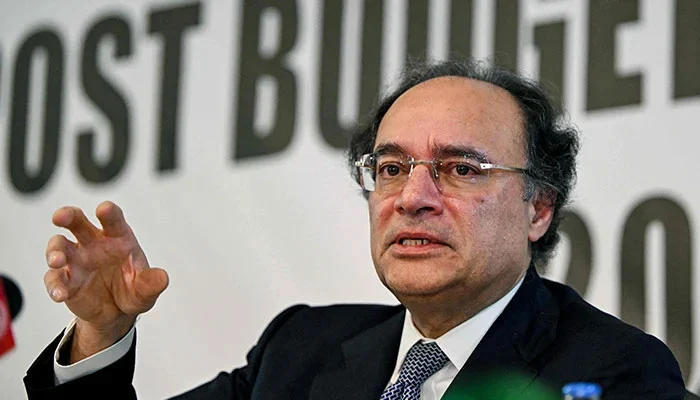
KARACHI: Federal Minister for Finance and Revenue, Senator Muhammad Aurangzeb, on Wednesday emphasized the need for a fundamental policy shift from reactive decision-making toward a proactive, reform-oriented, and growth-driven economic strategy. He called for restoring investor confidence and setting Pakistan on a sustainable development trajectory.
Speaking at the inaugural session of The Future Summit – 9th Edition, organized by Nutshell Group and co-hosted by the National Bank of Pakistan, the minister highlighted the government’s strong focus on structural reforms, fiscal discipline, and strategic partnerships as key drivers to redefine the country’s economic path.
Drawing on his recent interactions in Washington and Riyadh, Aurangzeb noted that global economies have shown remarkable resilience through structural reforms and greater private sector participation. He said Pakistan must follow suit by shifting from state-led dependency to a productivity-based, private sector–driven growth model, leveraging technological and AI-led innovation.
The Finance Minister reaffirmed that Pakistan’s macroeconomic stability has now been achieved and externally validated. Major global rating agencies have upgraded the country’s outlook, while the IMF’s second review under its ongoing program has been successfully completed. “Macroeconomic stability is not an end in itself — it is the foundation for sustained investment and long-term growth,” he remarked.
Highlighting positive indicators, Aurangzeb revealed that corporate profitability in Pakistan rose by 14 percent during the first nine months of 2025, and that 73 percent of CEOs in the latest OICCI survey now view Pakistan as a viable investment destination, up from 61 percent previously. He said these metrics reflect growing investor confidence and an improving business climate.
Senator Aurangzeb outlined a convergence of favorable trends, including improved macroeconomic fundamentals and geopolitical alignment, positioning Pakistan to convert bilateral support into private sector–led trade and investment. He reaffirmed the government’s focus on creating an enabling environment in key sectors such as minerals and mining, IT, agriculture, pharmaceuticals, and the blue economy.
Citing technological milestones, the minister lauded Google’s decision to open an office in Pakistan and establish the country as a regional technical and export hub. He underscored the importance of equipping Pakistan’s youth with digital and technical skills to seize opportunities in high-value domains such as coding, blockchain, and AI.
On the reform front, Aurangzeb asserted that Pakistan is “no longer in the design phase but in implementation mode.” He cited progress in taxation, energy, privatization, public finance management, pension and debt reforms, and the rightsizing of state institutions. He highlighted AI-led systems for tax monitoring and invoicing, the addition of 900,000 new tax filers, and recognition of Pakistan’s reform agenda by the World Bank.
The minister reaffirmed the government’s commitment to privatization, referencing the acquisition of a local bank by a UAE conglomerate and ongoing work on PIA and power distribution companies. He said loss-making entities such as Utility Stores Corporation and PASCO are being shut down, while a new defined-contribution pension model is being introduced for fresh government employees.
Focusing on The Future Summit’s theme, “Course Correction,” Aurangzeb identified two critical challenges — unchecked population growth and climate change — requiring urgent national action. He urged a united approach to address child stunting, learning poverty, and population expansion, while effectively utilizing USD 2 billion in climate-related financing available under the World Bank’s Country Partnership Framework.
Aurangzeb also disclosed that the International Monetary Fund (IMF) Executive Board is expected to approve Pakistan’s next USD 1.2 billion loan tranche in early December 2025, following a successful staff-level agreement in Washington in mid-October. He said this disbursement would reinforce Pakistan’s reform momentum and global economic credibility.


