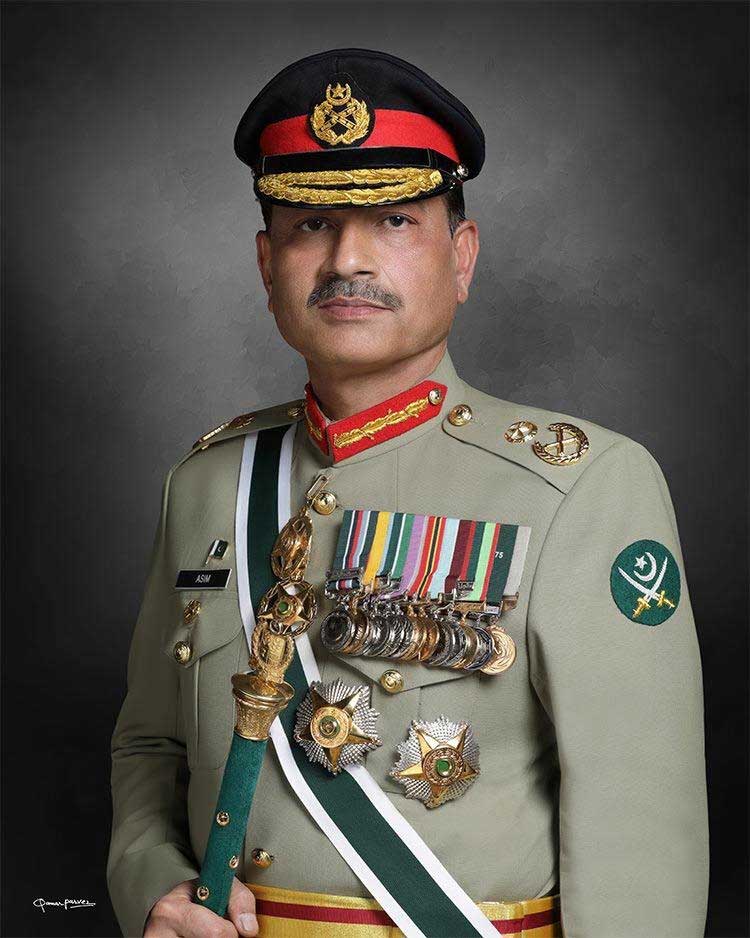

PART VII – Fighting terrorism: Asim Munir and the battle within Pakistan’s borders

When General Syed Asim Munirassumed command of the Pakistan Army in November 2022, terrorism was no longer merely a painful memory from Pakistan’s recent past. It was returning.
The country that had spent years dismantling militant networks, clearing territories and restoring state authority was once again witnessing attacks on soldiers, police personnel, civilians and strategic installations. The challenge was particularly acute in Khyber Pakhtunkhwa and Balochistan.
Along the western frontier, the Tehreek-i-Taliban Pakistan had re-emerged as a formidable threat. In Balochistan, separatist militant organisations were demonstrating increasingly sophisticated operational capabilities. Meanwhile, instability in neighbouring Afghanistan complicated Pakistan’s security calculations. For Asim Munir, therefore, the fight against terrorism would become one of the defining struggles of his command. And unlike the large-scale counterterrorism campaigns of an earlier era, this battle would increasingly be fought through intelligence, technology, targeted operations, border security and diplomatic pressure.
The return of a familiar enemy
Pakistan had seen this enemy before. From the late 2000s onward, the country fought an extraordinarily costly campaign against militant organisations. Operations such as Rah-e-Nijat and Zarb-e-Azb dismantled terrorist strongholds and significantly reduced the ability of militant organisations to openly control territory.
The price was immense.
Soldiers died.
Police officers died.
Civilians died.
Communities were displaced.
Cities endured bombings and suicide attacks.
For several years, however, terrorist violence declined substantially. There was hope that Pakistan had crossed its most dangerous phase. That optimism began to fade following the Taliban’s return to power in Afghanistan in August 2021. The geopolitical environment had changed.
The banned TTP, historically linked to sanctuaries and networks across the Afghan frontier, gained renewed operational space and confidence. Attempts were made to negotiate with the organisation during the previous Pakistani government. But the process failed. In November 2022, shortly before Munir became Army Chief, the TTP formally ended its ceasefire and announced renewed attacks. The timing could hardly have been more consequential. The new Army Chief inherited a war that Pakistan had hoped it was leaving behind.
The western frontier becomes the centre of gravity
Munir’s early visits after taking command demonstrated how seriously the military viewed the threat. Within days of becoming Army Chief, he visited Tirah Valley near the Afghanistan frontier. He later travelled to North Waziristan and other operational areas. These were not symbolic destinations. They represented the geography of Pakistan’s renewed counterterrorism challenge.

North and South Waziristan, Bannu, Dera Ismail Khan, Lakki Marwat, Tank and other parts of Khyber Pakhtunkhwa increasingly experienced militant violence. Police stations were attacked. Military convoys were targeted. Checkposts came under assault. Suicide bombings returned.
Security personnel once again found themselves fighting an enemy that rarely sought to hold large cities or territories, but instead relied on mobility, surprise, intelligence networks and cross-border sanctuary. This created a fundamentally different battlefield. There was no single front line. The enemy could strike and disappear. Counterterrorism therefore depended increasingly upon intelligence-based operations.
The Afghanistan problem
At the heart of Pakistan’s growing security concerns lay an increasingly difficult relationship with Afghanistan. Islamabad had initially hoped that the Taliban government in Kabul would prevent Afghan territory from being used against Pakistan. Instead, Pakistan repeatedly complained that TTP militants and their leadership were operating from Afghan soil. The Taliban authorities in Kabul disputed or rejected various Pakistani accusations and repeatedly maintained that Afghanistan should not be blamed for Pakistan’s internal security failures.
This produced a widening diplomatic gulf. For Islamabad, the issue was straightforward: friendship with Afghanistan could not coexist indefinitely with what Pakistan described as sanctuaries for militants attacking Pakistani citizens and security forces. For Kabul, Pakistani pressure was increasingly viewed as excessive and, at times, coercive. The disagreement gradually transformed what had once been expectations of strategic cooperation into one of Pakistan’s most difficult regional relationships.
For Munir, Afghanistan was therefore not simply a foreign-policy issue. It was directly connected to the safety of Pakistani soldiers and civilians. As attacks increased, Pakistan’s message hardened: the Afghan authorities had to ensure that their territory was not used for terrorism against Pakistan.
Balochistan – a different insurgency
The western security challenge was not confined to the TTP. Balochistan presented a different and increasingly complex threat. Militant separatist organisations, particularly the Balochistan Liberation Army and other armed groups, targeted security personnel, government installations, infrastructure projects and civilians. Chinese nationals and projects associated with the China-Pakistan Economic Corridor also became targets.
This added an international dimension to the conflict. An attack against Chinese engineers or workers was not merely a domestic security incident. It could affect Pakistan’s relationship with one of its most important strategic and economic partners. Militant organisations also demonstrated evolving tactics. High-profile assaults, suicide attacks, coordinated operations and attacks on transportation infrastructure showed that the Balochistan insurgency could not be treated as an ordinary law-and-order problem.
At the same time, the security response alone could not resolve Balochistan’s longstanding political, economic and governance grievances. Development, representation, employment, justice and public confidence remained essential to lasting stability. This balance—between defeating armed groups and addressing the conditions in which instability survives—would become increasingly important in Pakistan’s counterterrorism strategy.
From operations to a national campaign
By 2024, the government concluded that the counterterrorism campaign needed renewed national coordination. On June 22, 2024, Prime Minister Shehbaz Sharif chaired a meeting of the Central Apex Committee on the National Action Plan. General Asim Munir was among the key participants. The meeting approved a renewed national counterterrorism campaign: Azm-e-Istehkam – Resolve for Stability.
The name reflected its objective. But its nature was quickly misunderstood. Some political parties and communities feared that Pakistan was preparing another large-scale military operation similar to Zarb-e-Azb—one that could involve mass displacement from affected areas. The government subsequently clarified that Azm-e-Istehkam was not intended to be such an operation.
Pakistan no longer faced the same circumstances in which militants openly controlled large territories or established extensive no-go areas. Instead, the new strategy was described as a multi-domain, multi-agency and whole-of-system campaign. Intelligence-based kinetic operations would continue. But they would be combined with political, diplomatic, legal, socioeconomic and information measures. This distinction was critical. The enemy had changed. Therefore, the strategy had to change as well.
Intelligence becomes the battlefield
Under this evolving approach, intelligence-based operations became central. Rather than deploying enormous formations to clear entire regions, security forces increasingly acted on information identifying militant hideouts, facilitators and networks. The objective was precision.
Find the network.
Identify the commander.
Locate the weapons.
Disrupt financing.
Destroy logistical support.
Arrest facilitators.
Prevent the attack before it occurs.
This placed enormous importance on intelligence agencies, police counterterrorism departments and coordination among civilian and military institutions. It also meant that success was often invisible. A terrorist attack prevented by intelligence rarely receives the attention given to an attack that succeeds. Yet the growing frequency of militant violence demonstrated that operational successes had not eliminated the threat. The battle remained intense.
2025 – the war intensifies
By 2025, the scale of Pakistan’s internal-security challenge had become unmistakable. Data compiled by the Pakistan Institute for Conflict and Security Studies recorded 1,066 militant attacks during 2025, the highest annual number since 2014. The organisation recorded 3,413 fatalities linked to militant violence and security-force actions during the year, including militants, security personnel and civilians. It also documented a substantial increase in counterterrorism operations.
Security forces were not standing still. They were hitting militant networks repeatedly. More militants were being killed. More suspects were being arrested. But security personnel and civilians were also suffering heavy losses. This produced a sobering reality: Pakistan could achieve tactical successes and still face a worsening overall security environment.
Khyber Pakhtunkhwa remained a principal theatre of Islamist militancy, while Balochistan experienced some of the deadliest violence associated with separatist organisations. The battlefield was becoming both more active and more technologically complex. Small drones and other evolving methods increasingly entered the security equation. Counterterrorism was no longer the war Pakistan had fought a decade earlier.
Soldiers on the front line
Statistics can obscure the human reality of war. Every figure represents a family. Every soldier killed leaves parents, a spouse, children or siblings behind. Every police officer killed represents a community that has lost someone standing between civilians and violence. And every civilian death demonstrates the indiscriminate consequences of terrorism.
Throughout Munir’s tenure, he repeatedly visited operational formations and met soldiers serving in areas affected by militancy. Such visits form part of the traditional responsibilities of an Army Chief, but in this period they carried particular significance. Pakistan’s counterterrorism forces were again enduring a sustained operational tempo. The message from military leadership remained consistent: the campaign would continue until terrorist networks and their support structures were dismantled.
The battle for Balochistan
Balochistan increasingly demanded particular attention. Munir’s public messaging combined two themes. The first was uncompromising opposition to armed militancy. The second was the importance of development and governance. That distinction mattered.
Militant violence and legitimate political grievance are not the same thing. A state has the responsibility to protect citizens and confront organisations using terrorism. But lasting peace also requires citizens to believe that the state provides justice, opportunity and representation. By 2026, Munir was publicly emphasising a people-centred approach, inclusive development and improved governance alongside security operations in Balochistan. This reflected a broader lesson from decades of counterinsurgency around the world: militants can be defeated tactically, but sustainable peace requires political and socioeconomic foundations.
Afghanistan tensions reach a dangerous stage
Meanwhile, relations with Afghanistan continued deteriorating. Pakistan repeatedly demanded action against TTP sanctuaries and accused militants based across the border of participating in attacks inside Pakistan. International monitoring also increasingly highlighted the continuing TTP presence in Afghanistan.
By 2025 and 2026, border incidents and Pakistani strikes against alleged militant locations inside Afghanistan had pushed relations into an increasingly dangerous phase. Kabul objected strongly to Pakistani military actions. Islamabad maintained that it possessed the right to defend itself against terrorism originating beyond its borders.
The situation presented Munir with a difficult strategic equation. Pakistan did not need another conventional war on its western frontier. But neither could the Army Chief ignore attacks that the Pakistani state believed were being enabled from across that frontier. The challenge therefore involved military readiness, intelligence, diplomacy and deterrence simultaneously.
A war without an easy victory parade
The counterterrorism campaign under Asim Munir differed from conventional warfare in one fundamental respect. There was unlikely to be a single day of victory.
No enemy capital would fall.
No peace treaty would necessarily end the conflict.
No battlefield ceremony could guarantee that another militant cell would not emerge months later.
Success instead meant progressively reducing the enemy’s capacity to attack. It meant denying sanctuaries. Breaking financing networks. Securing borders. Improving policing. Strengthening intelligence. Countering extremist recruitment. And ensuring that areas cleared of militants were followed by governance, development and opportunity. That made Azm-e-Istehkam as much a test of the Pakistani state as of the Pakistan Army.
The campaign continues
By 2026, terrorism remained one of Pakistan’s gravest security challenges. Independent security monitoring continued to record high levels of militant activity, while the armed forces and law-enforcement agencies intensified intelligence-based operations. The battle had therefore not ended. Nor could the outcome responsibly be reduced to claims of complete victory or defeat.
The state had demonstrated substantial operational capacity and inflicted heavy losses on militant organisations. But those organisations had also demonstrated an ability to regenerate, adapt and continue attacking. That reality explains why Munir’s counterterrorism messaging increasingly combined military force with governance, development, border security and diplomatic pressure. Pakistan could kill terrorists. The more difficult task was destroying the ecosystem that continuously produced, protected, financed and replaced them.
Security at home, partnerships abroad
This struggle also had consequences far beyond Pakistan’s western frontier. Foreign investment required security. CPEC required security. Chinese engineers required protection. Ports, mines, highways and energy projects required stability. Pakistan’s relationships with Saudi Arabia, the UAE, China, the United States and other partners were all influenced in different ways by the country’s internal-security environment.
For Munir, therefore, counterterrorism was not separate from the economic-security agenda examined in Part VI. It was a prerequisite for it. The soldier who had entered office facing terrorism, political turmoil and economic crisis was increasingly operating across interconnected fronts.
At home, he had to confront militant organisations. Across the Afghan frontier, Pakistan had to combine pressure with diplomacy. In Balochistan, military action had to coexist with the need for governance and development. And internationally, Islamabad needed partners willing to invest in a country fighting to secure its own economic future.
Among those partners, none was more strategically important than China. China was Pakistan’s largest infrastructure partner, a central pillar of CPEC and one of Islamabad’s most important defence relationships. But repeated terrorist attacks on Chinese citizens had created an urgent challenge. Protecting the Pakistan-China relationship now required more than diplomatic declarations about an “iron brotherhood.” It required protecting Chinese lives, safeguarding CPEC projects and convincing Beijing that Pakistan could provide the security necessary for the next phase of cooperation.
That challenge would open the next chapter in Asim Munir’s journey.