

Abdul Rafay
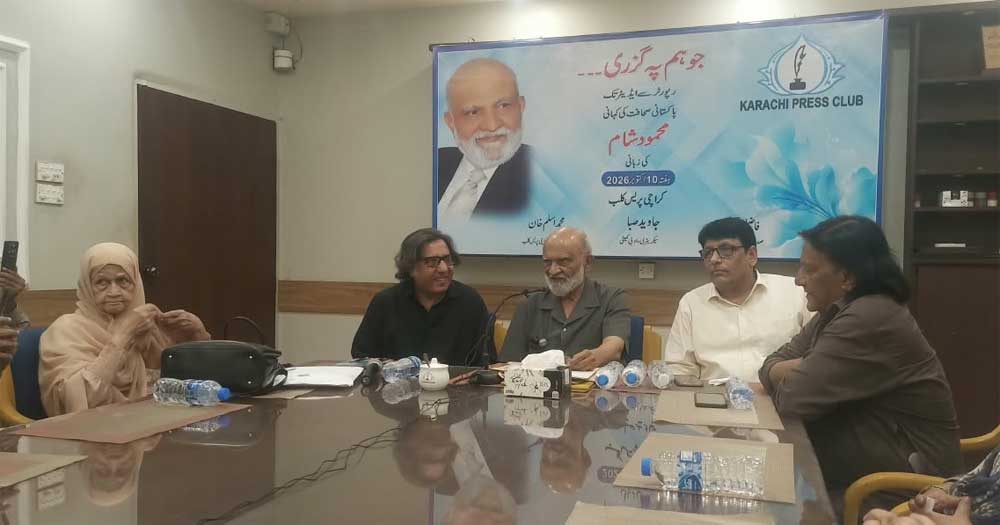
KARACHI: The Literary Committee of the Karachi Press Club organized a special session titled “Jo Hum Pe Guzri” (What We Have Been Through) with senior journalist, poet and writer Mahmood Sham at the club’s boardroom. He shared his experiences spanning decades of journalism, important events in Pakistan’s political history, interactions with political leaders, press censorship, restrictions on newspapers and the struggle for press freedom.
The session was attended by Karachi Press Club President Fazil Jamili, Secretary Muhammad Aslam Khan, Literary Committee Secretary Javed Saba, Karachi Union of Journalists (Dastoor) representative Nasrullah Chaudhry, former Joint Secretary Abid Hussain, former Treasurer Naseer Ahmed, KUJ Treasurer Muhammad Nasir, senior journalist Nadeem Siddiqui, and a large number of journalists and writers.
Sharing his professional journey, Mahmood Sham said he belonged to Jhang, where his interest in literature, reading and writing developed during his student days. His early engagement with poetry and writing eventually led him to journalism. He also recalled his meetings with prominent writers and poets and the publication of his early work in newspapers and literary magazines.
He emphasized that journalism is not merely about collecting and publishing news; it requires extensive reading, observation, research, historical awareness and professional integrity. He advised journalists to take notes during events and preserve important details in their original context, as these form the foundation of accurate and authentic reporting.
Recalling important periods in Pakistan’s political history, Mahmood Sham shared his experiences of interviewing political leaders, including Zulfikar Ali Bhutto, and covering significant historical developments, including the Simla Agreement and key phases of Pakistan-India relations. He observed that journalists are not merely witnesses to their times; their writings can also become valuable historical documents for future researchers and historians.
He also recalled instances of government pressure on newspapers, censorship, notices issued under press laws and the cancellation of publication declarations. He said journalists and media organizations had faced challenges under successive governments, but the true strength of journalism lay in accurately presenting facts and providing information to the public.
Mahmood Sham also shared memories of his association with Nawa-i-Waqt, its editor Majeed Nizami and other senior media personalities. He highlighted the importance of editorial independence, accuracy and adherence to professional standards, stressing that media organizations must protect public trust despite external pressures.
Discussing the relationship between literature and journalism, he said his literary background had given his journalistic writing a distinctive character. Poetry, language and keen observation influenced his writing, while journalism enabled him to closely examine society, politics and human life.
Welcoming the participants, Karachi Press Club President Fazil Jamili said Mahmood Sham was not only a witness to significant events in his own professional life but had also closely observed major developments throughout Pakistan’s 79-year history.
He said Mahmood Sham had progressed through various stages of journalism to become an editor and had served for a long period as Group Editor of the Jang Group. His extensive experience of journalism and close observation of Pakistan’s political landscape made his recollections valuable for understanding the country’s history.
Fazil Jamili observed that Mahmood Sham’s deep association with literature was clearly reflected in his journalism through his command of language, literary expression and depth of observation. He said journalists and writers had long admired Mahmood Sham and sought to learn from his professional excellence.
He particularly appreciated Mahmood Sham’s habit of maintaining detailed notes and diaries during official visits abroad, including trips accompanying heads of government. According to Fazil Jamili, Sham’s ability to record observations during events and later transform them into comprehensive, well-structured accounts reflected exceptional journalistic skill.
He further noted that Mahmood Sham had worked alongside important political personalities, including Zulfikar Ali Bhutto, and covered historic developments such as the Simla Agreement. Through his reporting and writings, he had helped preserve important chapters of Pakistan’s history.
During the interactive session, participants asked Mahmood Sham questions about his early life, entry into journalism, meetings with historical figures and experiences under different political regimes. Responding to their questions, he emphasized that reading, observation, research and professional integrity were essential for young journalists seeking to excel in the profession.