

Naeem Awan
ISLAMABAD: Pakistan’s political and security crisis deepened Sunday after President Asif Ali Zardari approved the imposition of emergency and governor’s rule in Khyber Pakhtunkhwa, effectively suspending the PTI-led provincial administration, while the federal government separately authorised deployment of Pakistan Army troops and assets across the province.
The decision came following an emergency meeting of the federal cabinet chaired by Prime Minister Muhammad Shehbaz Sharif, which recommended invoking constitutional powers under Articles 232 and 234 amid what the government described as a rapidly deteriorating security situation and the provincial government’s failure to adequately cooperate in the fight against terrorism.
President Zardari subsequently approved the prime minister’s advice, paving the way for Governor Faisal Karim Kundi to assume the functions of the provincial government under the new arrangement.
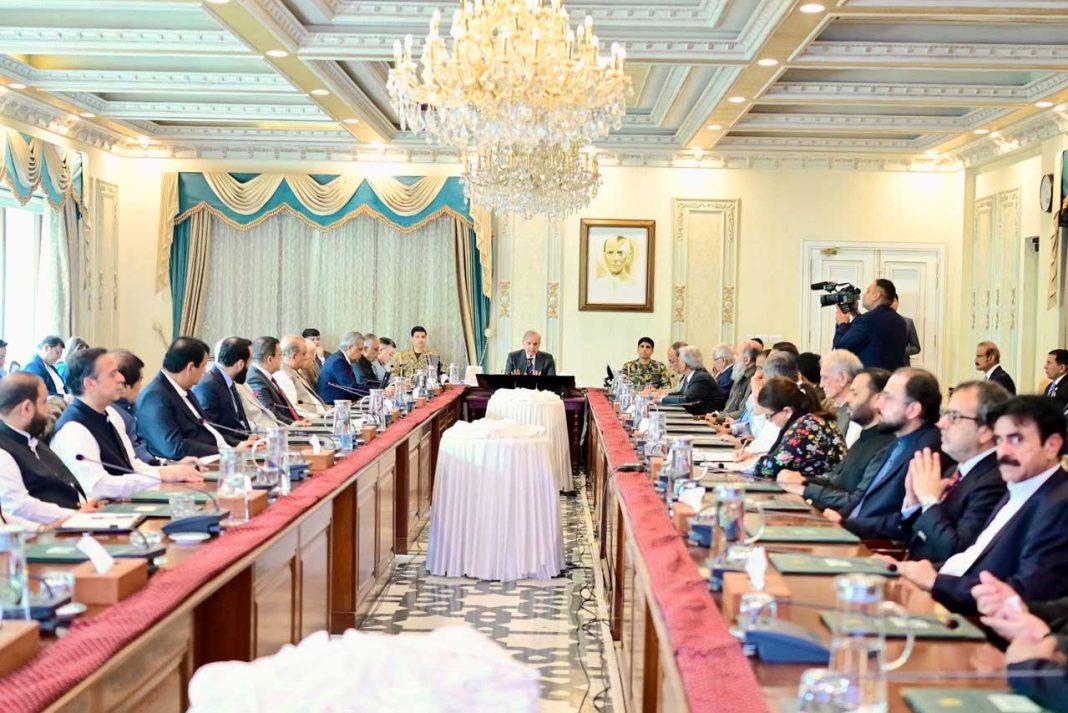
The federal government has also constituted an 11-member advisory council to assist the governor in administering the province. Governor Kundi chaired the council’s first meeting on Sunday and said restoration of peace, public security and the writ of the state would be his foremost priorities.
In another major development, the Interior Ministry authorised deployment of Pakistan Army troops and assets in Khyber Pakhtunkhwa under Article 245 of the Constitution in aid of civil power.
According to the federal directive, troops have been called in for the protection of lives and property, security of citizens and safeguarding government installations. The deployment is to remain in effect during the emergency period.
Security was tightened across Peshawar following the announcement. Shipping containers were placed on several important roads, large contingents of police and other law-enforcement personnel were deployed around sensitive installations and access to parts of the provincial capital was restricted. Disruptions to mobile and internet services were also reported in some areas, although there was no confirmation of a province-wide communications shutdown.
The developments also triggered uncertainty over the whereabouts of former chief minister Sohail Afridi and senior PTI leaders.
KP Information Minister Shafi Jan and other PTI lawmakers claimed that Afridi and PTI’s provincial president Junaid Akbar had been taken into custody after the emergency was imposed. The PTI subsequently condemned their reported detention and demanded their immediate release.
However, there was no immediate official confirmation specifically identifying Afridi among those detained. Minister of State for Interior Tallal Chaudhry acknowledged that some individuals had been taken into custody because of the law-and-order situation but did not confirm whether Afridi was among them. Reuters separately reported that restrictions had been placed on Afridi’s movements, citing one of his aides.
The emergency marks a dramatic escalation of the confrontation between the PML-N-led federal government and the PTI, whose government in Khyber Pakhtunkhwa represented the party’s principal centre of political power.
Prime Minister Shehbaz Sharif, while addressing the cabinet before the decision, accused the provincial administration of failing to respond effectively to the growing terrorist threat, particularly in areas including Tank and Dera Ismail Khan.
He said civilians, police personnel and security forces had continued to suffer attacks while the provincial leadership had failed to demonstrate sufficient commitment to a coordinated counterterrorism strategy.
The federal government has described the situation as one involving the provincial administration’s “deliberate disengagement from the fight against terrorism”, an accusation strongly rejected by the PTI.
The prime minister also referred to earlier efforts by federal coalition leaders and PTI representatives to reach an understanding on security and political issues, saying negotiations had failed despite progress towards a consensus document.
He accused the provincial leadership of prioritising political agitation and plans for a march towards Islamabad over cooperation with the Centre on counterterrorism.
The PTI, however, rejected the federal government’s justification, describing the emergency and governor’s rule as unconstitutional, undemocratic and an attack on the mandate of the people of Khyber Pakhtunkhwa.
PTI Chairman Barrister Gohar Ali Khan said there was no disagreement over the need to eliminate terrorism but maintained that counterterrorism could not be used as a justification for weakening provincial autonomy or pursuing political objectives.
He said peace required national unity, dialogue and a joint security strategy rather than confrontation between the federation and provinces. The PTI has announced that it will challenge the imposition of governor’s rule through constitutional, judicial and political forums.
Jamiat Ulema-e-Islam-F chief Maulana Fazlur Rehman, who had been involved in efforts to mediate between the government and PTI, also criticised the emergency, describing it as an attack on democracy.
Under the new administrative arrangement, Governor Faisal Karim Kundi will exercise the functions of the provincial government with assistance from the 11-member advisory council.
The government has also moved to restructure administration in some of the areas most severely affected by militancy.
An Area Development Secretariat has been ordered for 12 designated districts, including Dera Ismail Khan, Tank, Lakki Marwat, Bannu, Bajaur, Mohmand, Khyber, Kurram, Orakzai, North Waziristan, Upper South Waziristan and Lower South Waziristan. The arrangement is intended to strengthen administration, security, development and law enforcement in the affected areas.
The emergency also raises important constitutional questions.
Article 232 deals with proclamation of emergency where the security of Pakistan or any part of the country is threatened by war, external aggression or internal disturbance beyond the capacity of a provincial government to control.
Article 234 deals with failure of the constitutional machinery in a province and permits the president to assume specified provincial functions. Under Article 234, such a proclamation must be placed before a joint sitting of Parliament and cannot ultimately remain in force for more than six months.
The federal government’s decision comes against the backdrop of a sharp rise in militant violence in Khyber Pakhtunkhwa, continuing tensions with Afghanistan over cross-border militancy and an escalating political confrontation surrounding PTI’s planned protest movement for the release of former prime minister Imran Khan.
Hundreds of PTI activists have reportedly been detained in connection with the planned demonstrations, while Islamabad and Peshawar have witnessed extensive security preparations.
The government insists the extraordinary measures are aimed at restoring security and strengthening the state’s ability to confront terrorism rather than targeting a particular political party.
Governor Kundi, addressing the first meeting of his advisory council, said the government’s fight was against terrorism and its supporting networks and not against any nationality, political group or section of society.
PTI, however, maintains that the timing of the emergency – coinciding with its protest campaign – demonstrates that political considerations are inseparable from the federal government’s decision.
With the elected provincial administration sidelined, the Army deployed in aid of civil power and PTI preparing legal and political resistance, the crisis has now entered a new and potentially decisive phase, with its constitutional, political and security repercussions likely to extend well beyond Khyber Pakhtunkhwa.