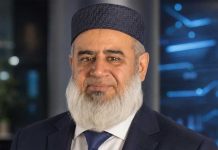
KARACHI: Pakistan is currently enjoying a rare and favourable diplomatic position that can serve as a catalyst for economic transformation, according to Shahzad Arif.
Shahzad Arif is the Chief Executive Officer of AKSiQ and a seasoned technology leader with more than two decades of experience driving innovation, digital transformation, and business growth in Pakistan’s IT sector. Throughout his career, he has built and led high-performance technology teams, delivered enterprise-scale digital solutions, and championed stronger collaboration between industry and academia to enhance Pakistan’s competitiveness in the global technology marketplace. As a regular contributor to policy and industry discussions, Arif is a prominent advocate for expanding IT exports, developing digital talent, and leveraging emerging technologies to accelerate Pakistan’s economic growth and digital future.
Speaking on Pakistan’s evolving economic outlook, Shahzad Arif said the country’s strengthening relationship with the United States, the second phase of the China-Pakistan Economic Corridor (CPEC), and enduring partnerships with Gulf nations collectively provide an unprecedented opportunity for sustainable growth.
“These relationships should not be viewed as competing alignments but as complementary partnerships that can help Pakistan leverage its strategic location at the crossroads of South Asia, China, the Gulf and Central Asia,” Shahzad said. He stressed that the key challenge now is converting diplomatic goodwill into tangible gains for industry, agriculture, technology and exports.
According to Shahzad Arif, the nature of Pakistan’s international engagements has evolved significantly, with commerce, investment and innovation replacing traditional aid-based relationships. He noted that recent high-level discussions between Pakistan and the United States focused on minerals, artificial intelligence, energy and emerging technologies, reflecting a growing emphasis on mutually beneficial economic cooperation.
He pointed to the minerals sector as one of the most promising opportunities. Referring to Pakistan’s $500 million framework agreement with US Strategic Metals signed in September 2025, he said the country’s first exports of antimony, copper concentrate and rare earth elements marked an important step toward unlocking Pakistan’s vast mineral potential.
“Pakistan possesses world-class mineral resources, including the copper and gold reserves of Reko Diq,” Shahzad Arif said. However, he emphasized that long-term success would require security, policy consistency and meaningful benefits for local communities. He added that the country should prioritize domestic processing and refining to capture greater value rather than exporting raw materials.
Discussing the information technology sector, Shahzad said Pakistan was already demonstrating strong growth momentum. He noted that IT and IT-enabled services exports reached approximately $3.8 billion during the first ten months of the current fiscal year, representing growth of around 21 percent compared to the previous year.
Shahzad Arif attributed this performance to a successful 5G spectrum auction, expanding internet connectivity and reforms that allow exporters to retain a greater share of their foreign earnings. With nearly one million freelancers and limited dependence on imports, he said the sector is well-positioned for further expansion.
“Improved relations with the United States and the strength of Pakistan’s overseas diaspora can help local technology companies move beyond services into higher-value digital products,” Shahzad observed, adding that continued improvements in payment systems, talent retention and digital infrastructure would be essential.
Turning to textiles, Shahzad Arif described the sector as the backbone of Pakistan’s export economy, generating roughly $16 billion annually. He said continued access to European markets under the GSP+ framework provides a strong foundation for growth.
However, Shahzad Arif argued that Pakistan must move beyond low-value textile exports and focus on finished garments, home textiles and technical textiles where profit margins are significantly higher. He also highlighted the potential for Pakistan’s Special Economic Zones to attract manufacturing relocation from China and other countries seeking alternative production destinations.
On agriculture, he said the sector remains one of Pakistan’s most important economic assets and stands to benefit considerably from the next phase of CPEC. Shahzad Arif highlighted opportunities in modern seed technology, efficient irrigation systems, cold-chain logistics and food processing.
“Pakistan should treat agriculture as a modern industry rather than merely a sector requiring support,” Shahzad said. He explained that improvements in productivity and value addition could simultaneously boost rural incomes and national export earnings while supporting related industries such as textiles.
Shahzad Arif also identified defence manufacturing as an emerging success story. He noted that the JF-17 Thunder programme has generated significant international interest and secured important export agreements during 2025.
According to Arif, the growth of aerospace and defence manufacturing demonstrates Pakistan’s expanding engineering capabilities and could support broader industrial diversification into higher-value manufacturing sectors.
Discussing CPEC’s evolving role, Shahzad Arif said the corridor’s second phase represents a strategic shift from infrastructure development toward industrial cooperation and business-to-business investment. He noted that Special Economic Zones and long-term tax incentives could help attract manufacturers, encourage technology transfer and strengthen domestic value-added production.
Despite the opportunities, Shahzad severely cautioned that success would depend primarily on domestic reforms. He emphasized the importance of maintaining macroeconomic stability, continuing fiscal and energy sector reforms, ensuring policy predictability and improving infrastructure.
“Foreign confidence can accelerate Pakistan’s progress, but it cannot substitute for the reforms and investments that must be undertaken at home,” Shahzad Arif stated.
“Pakistan’s geography is increasingly becoming a strategic advantage rather than a burden. The United States seeks a dependable economic and security partner, China seeks a secure and upgraded economic corridor, and Gulf nations seek trusted partners for investment and trade.If Pakistan maintains policy consistency and follows through on its economic agenda, this period could be remembered as the moment the country successfully transformed favourable diplomacy into durable economic momentum,” Shahzad Arif, Chief Executive Officer of AKS iQ tells The Financial Daily.