Imran Zakir
KARACHI: Pakistan’s corporate boards need to move beyond compliance and play a more active role in dealing with economic uncertainty, technological disruption, cyber security, sustainability and succession challenges, business leaders and governance experts said at the Pakistan Institute of Corporate Governance (PICG) Directors’ Summit 2026.
Held under the theme “The Showcase: Your Leadership, Your Impact”, the summit brought together more than 350 directors, business leaders, regulators and senior executives to discuss how stronger governance could help build resilient and future-ready institutions.
In his welcome address, PICG Chairman Muhammad Ashraf Bawany said good governance was increasingly about building trust, creating sustainable value and strengthening institutions rather than merely fulfilling compliance requirements.
“Through better leadership and stronger boards, we can help build a more prosperous and resilient Pakistan,” he said.
PICG CEO Shafaq Fauzil Azim also addressed the gathering. The summit paid tribute to the late Dr Shamshad Akhtar for her leadership and contribution to Pakistan’s economic development, governance and public institutions.
Chief guest Muhammad Ali Tabba, Chairman, YBG, said: “Good governance is not the price of doing business – it is the foundation on which business is done.”
A panel on agile boards discussed the need for companies to prepare for geopolitical, supply-chain, economic and climate risks through scenario planning, resilient capital allocation and stronger decision-making.
The Family Legacy panel focused on succession and governance in family-owned businesses, stressing the importance of balancing legacy with reinvention, family ownership with professional management, and continuity with merit and inclusion.
Naveen Balkhi called for greater participation of women on corporate boards and urged the Securities and Exchange Commission of Pakistan (SECP) to restructure boards where women’s representation remained inadequate. Saadia Naveed, Deputy Managing Director of English Biscuit Manufacturers, discussed the role of family values in corporate governance.
A former minister and Board of Investment (BOI) ,Azfar Ahsan expressed concern over Pakistan’s continuing decline in foreign direct investment, saying the country lacked a sustained investment strategy and long-term planning. He cited frequent changes in key institutions, including 18 FBR chairmen in three years, as evidence of institutional instability.
He said Pakistan had failed to capitalise on changing global opportunities, while millions of children remained out of school, and stressed the need to facilitate investors rather than relying primarily on borrowing.
Kabeer Naqvi of Abhi Microfinance Bank highlighted governance as an enabler of digital banking innovation and financial inclusion, while Zaffar A. Khan, Chairman, PCP, stressed that governance, leadership and institutional capacity were essential for the non-profit sector.
Dr Syed Amir Ali, CEO of Meezan Bank, discussed the integration of sustainability, governance and innovation into Islamic finance and outlined the concept of Islamic governance.
In his closing keynote, Hussain Dawood, Chairman, Engro Holdings, Emphasized visionary leadership, responsible decision-making, trust and resilience as foundations of lasting institutional value.
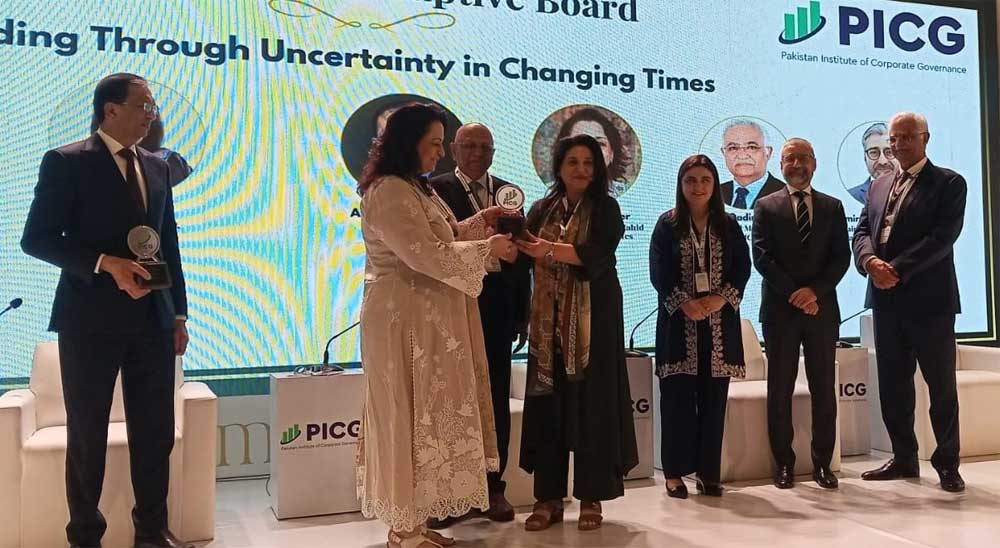
The summit concluded with the PICG Recognition Awards, with the institute reaffirming its commitment to anticipating disruption, challenging assumptions and acting decisively to build stronger and more sustainable organisations.